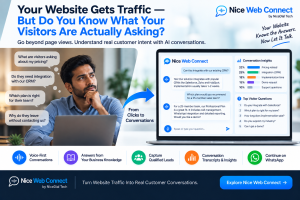
A potential customer visits your website at 11:30 PM and asks:
“Hi, I’m interested in your solution. Can you tell me the pricing?”
What happens next?
In many businesses, nothing happens until the sales team comes online the next morning.
By then, the prospect may have already contacted two or three competitors.
An AI Sales Agent changes this.
Instead of making prospects wait, an AI Sales Agent can start the first customer conversation instantly, understand what the customer needs, answer approved questions, qualify the opportunity, collect important information, and move the prospect toward the appropriate next step.
Your sales team can then focus on what humans do best: building relationships, demonstrating value, negotiating, and closing deals.
What Is an AI Sales Agent?
An AI Sales Agent is an AI-powered conversational system designed to handle parts of the sales process automatically.
Unlike a traditional chatbot that primarily follows predefined menus or decision trees, an AI Agent can conduct more natural conversations and use the context of the interaction to determine the appropriate response.
An AI Sales Agent can help with tasks such as:
- Responding to new enquiries
- Understanding customer requirements
- Answering common product questions
- Asking qualification questions
- Capturing lead information
- Identifying customer intent
- Scheduling demos or appointments
- Updating connected CRM systems
- Following up with prospects
- Transferring qualified opportunities to sales representatives
Think of it as a 24×7 digital sales assistant that handles the first stage of customer engagement.
Why the First Customer Conversation Matters
The first interaction can significantly influence whether a prospect continues engaging with your business.
Customers increasingly expect fast responses.
Imagine two companies offering similar products.
Company A
Customer submits an enquiry.
Response: “Thank you. Our sales team will contact you shortly.”
The salesperson calls the next day.
Company B
Customer submits an enquiry.
Within seconds:
AI Sales Agent:
“Hi! Thanks for your interest. I can help you with that. What solution are you looking for?”
The customer immediately begins explaining their requirement.
Which experience feels more responsive?
The second business has already started understanding the customer before a salesperson becomes involved.
How an AI Sales Agent Automates the First Conversation
A typical AI-powered sales journey could look like:
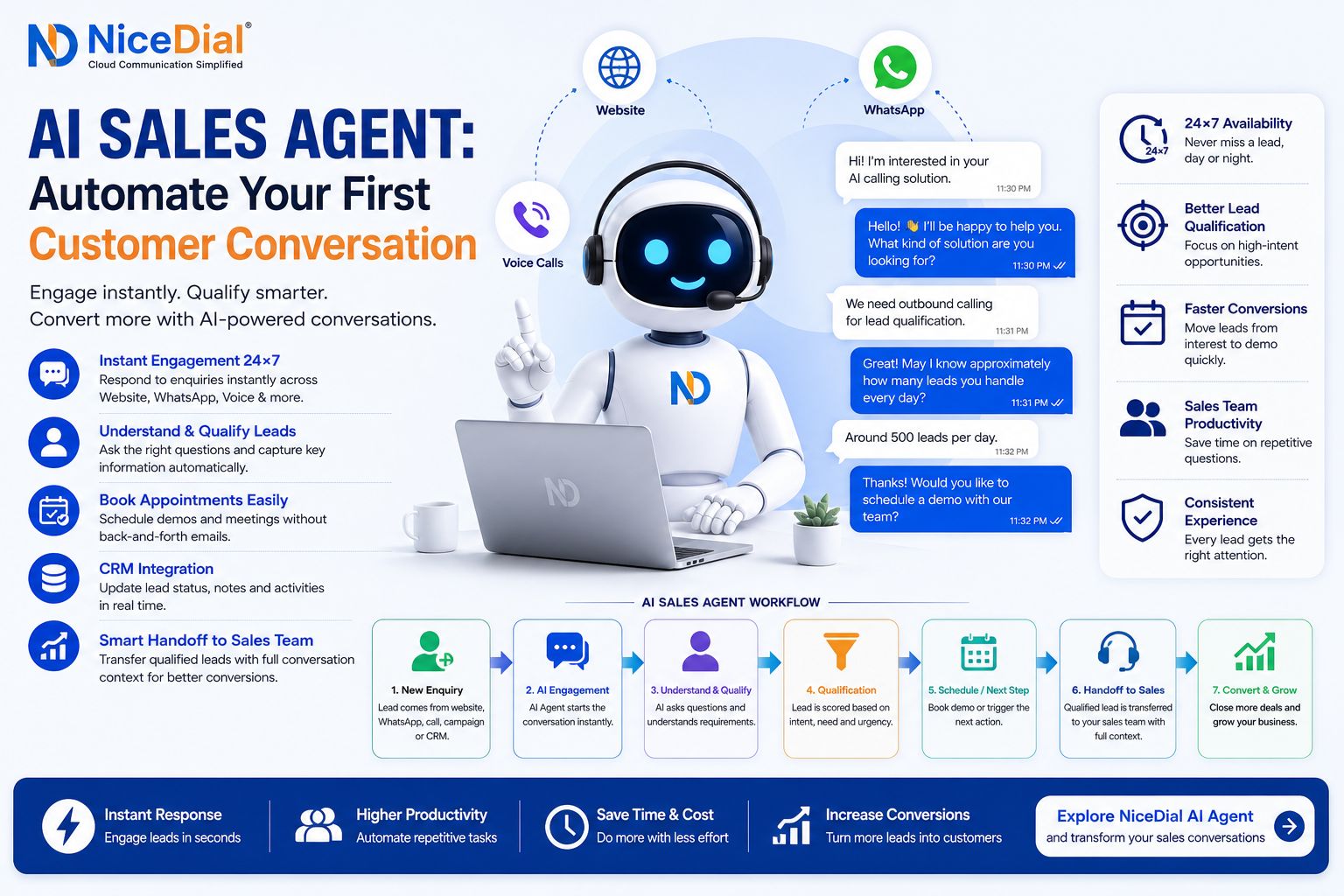
New Enquiry → AI Conversation → Understand Requirement → Qualify Lead → Recommend Next Step → Book Demo → Human Sales Agent
Let’s look at each stage.
1. Respond to New Leads Instantly
Leads can arrive from many sources:
- Website forms
- Landing pages
- Marketing campaigns
- Phone calls
- Existing databases
- CRM systems
- Social campaigns
Instead of waiting for someone from sales to notice the enquiry, an AI Agent can initiate or continue an approved customer interaction immediately.
For example:
Customer:
“I want to know more about your AI Voice Bot.”
AI Sales Agent:
“Sure. Are you looking for an AI Voice Bot for inbound customer support, outbound calling, or both?”
The sales conversation has already started.
2. Understand What the Customer Actually Wants
One of the biggest limitations of basic automation is that every prospect gets almost the same response.
But customers have different requirements.
One customer may need:
“WhatsApp automation for our hospital.”
Another might need:
“An AI calling solution for loan leads.”
Another may say:
“We need a contact center for 100 agents.”
An AI Sales Agent can ask relevant follow-up questions based on the conversation.
This creates a much more useful customer experience than forcing every prospect through the same menu.
3. Ask Lead Qualification Questions
Not every enquiry has the same sales potential.
Your AI Agent can collect information that helps your sales team understand the opportunity.
Depending on your business, questions might include:
Company:
“What company are you representing?”
Requirement:
“Which solution are you interested in?”
Team Size:
“How many users or agents would require the solution?”
Use Case:
“Are you looking for sales, support, appointment booking, or another workflow?”
Timeline:
“When are you planning to implement the solution?”
Existing Setup:
“Are you currently using another CRM or contact center platform?”
The questions should be tailored to the product and should not turn the conversation into a long interrogation.
The goal is to collect enough information to determine the best next step.
Example: AI Sales Agent Conversation
Suppose a prospect visits the NiceDial website.
Customer
“We need WhatsApp automation for our hospital.”
AI Sales Agent
“Sure. What would you primarily like to automate—appointment booking, patient enquiries, reminders, or customer support?”
Customer
“Appointment booking and reminders.”
AI Sales Agent
“Understood. Approximately how many appointment enquiries do you receive each day?”
Customer
“Around 300.”
AI Sales Agent
“Thanks. We can help you explore an automated workflow for appointment enquiries and reminders. Would you like to schedule a demo with our team?”
Within a short conversation, the system has captured:
Industry: Healthcare
Requirement: WhatsApp automation
Use Case: Appointment booking + reminders
Volume: ~300 enquiries/day
Intent: Interested in demo
Now compare that with a salesperson receiving only:
“New Website Lead — Hospital”
The first scenario gives the sales representative significantly more context before speaking with the customer.
4. Answer Common Sales Questions
Sales teams repeatedly answer similar questions:
- What does the product do?
- Which industries do you support?
- Does it integrate with CRM?
- Can it work with WhatsApp?
- Does it support voice calls?
- Can it transfer to human agents?
- Can it book appointments?
- Does it support multiple languages?
- How does implementation work?
An AI Sales Agent can be configured with approved business information so that many common questions can be handled during the initial conversation.
However, the AI should have clearly defined boundaries.
Questions involving complex commercial negotiations, unusual requirements, commitments, or information outside its approved knowledge should be escalated to a human.
5. Identify High-Intent Leads
Consider these two prospects.
Prospect A
“Just checking what AI Agents are.”
Prospect B
“We need an AI calling solution for 50 agents and want to implement it this month. Can we schedule a demo?”
Both are leads.
But their sales intent is very different.
An AI Sales Agent can collect signals such as:
- Product interest
- Business requirement
- Company size
- Expected volume
- Implementation timeline
- Demo request
- Pricing interest
- Integration requirement
Businesses can then define their own lead qualification rules.
For example:
High Intent → Immediate Sales Handoff
Medium Intent → Continue Qualification / Nurture
Early Research → Provide Information / Follow-Up Workflow
This helps the sales team prioritize conversations more effectively.
6. Automatically Schedule a Demo
A common sales conversation looks like this:
Customer:
“Can I get a demo?”
Salesperson:
“Sure. When are you available?”
Customer:
“Tomorrow afternoon.”
Salesperson:
“Does 3 PM work?”
Customer:
“Can we do 4 PM?”
Several messages may be exchanged simply to schedule one meeting.
With calendar or scheduling integration, an AI Sales Agent can help streamline this process.
The goal is simple:
Customer Interested → Demo Requested → Available Slot → Meeting Scheduled
Reducing friction between interest and demonstration can make the sales journey much smoother.
7. Send the Conversation Context to Sales
This is one of the most important capabilities.
When a human salesperson takes over, they shouldn’t have to ask the customer all the same questions again.
The sales representative could receive a summary such as:
Lead: ABC Healthcare Pvt Ltd
Product: WhatsApp Automation
Use Case: Appointment Booking
Daily Enquiries: ~300
CRM: Existing hospital management system
Timeline: Within 30 days
Demo: Requested
Lead Intent: High
The salesperson can start with:
“I understand you’re looking to automate around 300 daily appointment enquiries.”
That’s a much stronger beginning than:
“So, how can I help you?”
8. Connect AI Sales Agents With Your CRM
An AI Sales Agent becomes even more valuable when connected with your existing business systems.
Depending on the integration, the AI Agent can potentially:
- Create new leads
- Search existing customers
- Update lead status
- Add conversation notes
- Record requirements
- Assign leads
- Create follow-up activities
- Schedule appointments
- Trigger workflows
- Retrieve relevant customer information
This creates a connected sales journey:
Customer Conversation ↔ AI Agent ↔ CRM ↔ Sales Team
Instead of customer conversations and CRM data existing separately, they become part of the same workflow.
AI Sales Agent for Voice and WhatsApp
AI-powered sales conversations don’t have to be limited to website chat.
Businesses can build AI-assisted customer journeys across multiple communication channels.
AI Voice Agent
An AI Voice Agent can handle phone conversations for use cases such as:
- Initial lead qualification
- Product enquiries
- Callback requests
- Appointment confirmation
- Lead follow-up
- Customer verification
- Sales qualification
Instead of traditional:
“Press 1 for Sales. Press 2 for Support.”
Customers can explain what they need naturally.
WhatsApp AI Agent
WhatsApp can be particularly useful for conversational sales workflows.
Customers can ask questions, provide information, request demonstrations, and continue conversations without repeatedly filling forms.
The AI Agent can handle the initial interaction before transferring the conversation to a salesperson when necessary.
AI Sales Agent vs Traditional Chatbot
| Traditional Chatbot | AI Sales Agent |
|---|---|
| Primarily predefined flows | More conversational interactions |
| Menu-driven experience | Natural-language conversations |
| Limited context | Can use conversation context |
| Basic FAQs | Multi-step sales conversations |
| Fixed qualification flow | Adaptive follow-up questions |
| Simple routing | Contextual human handoff |
| Limited business actions | Can connect with CRM and tools |
Traditional chatbots remain useful when the process is predictable.
AI Agents become more valuable when customers may ask different questions and the system needs to understand the conversation before determining the next action.
Does an AI Sales Agent Replace Salespeople?
No.
For most businesses, the better strategy is:
AI Handles the First Mile
AI can handle:
- Instant response
- Basic questions
- Requirement collection
- Lead qualification
- Repetitive follow-up
- Appointment scheduling
- CRM updates
Humans Handle the Critical Mile
Salespeople handle:
- Complex discussions
- Product demonstrations
- Solution design
- Negotiations
- Pricing exceptions
- Relationship building
- Objection handling
- Closing
The objective isn’t:
AI vs Sales Team
It’s:
AI Agent + Sales Team
Benefits of Using an AI Sales Agent
24×7 Lead Engagement
Your business can continue handling initial enquiries outside normal working hours.
Faster Response
Prospects can receive an immediate response rather than waiting for an available salesperson.
Better Lead Qualification
Your team receives useful information before starting the sales conversation.
Increased Sales Productivity
Sales representatives can spend less time asking repetitive introductory questions.
Consistent Conversations
Important qualification questions and workflows can be standardized across leads.
Better Customer Experience
Customers can get answers and move forward without unnecessary delays.
Scalable Sales Operations
Businesses can handle larger enquiry volumes without requiring manual effort to grow at exactly the same rate.
Where NiceDial AI Agent Fits In
NiceDial AI Agent is designed to help businesses automate conversational customer interactions while keeping human teams available for situations where their expertise matters.
Businesses can use AI Agents for workflows such as:
- Sales enquiries
- Lead qualification
- Product enquiries
- Lead follow-up
- Appointment booking
- Customer support
- Voice conversations
- WhatsApp conversations
- CRM-connected workflows
- Human-agent escalation
The objective is to create a customer journey where automation handles repetitive interactions while your team focuses on higher-value conversations.
From New Lead to Qualified Conversation
The traditional process often looks like:
Lead Generated → Wait → Salesperson Calls → Qualification Starts
With an AI Sales Agent:
Lead Generated → AI Responds → Requirement Understood → Lead Qualified → Demo Scheduled → Salesperson Takes Over
That changes the role of automation.
Instead of simply capturing leads, your website, WhatsApp, voice channel, and CRM can become part of an intelligent sales engagement workflow.
Start Your First Customer Conversation With AI
Your next customer may enquire tonight.
They may ask about pricing.
They may want a demo.
They may have an urgent requirement.
The question is:
Will they have to wait for your sales team to come online?
With an AI Sales Agent, the first conversation can start immediately.
Let AI handle the repetitive first steps while your sales team focuses on understanding customers, building relationships, and closing opportunities.
🚀 Explore NiceDial AI Agent
Discover how NiceDial AI Agent can help automate customer conversations, qualification, and intelligent sales workflows.
👉 Learn More / Request a Demo:
https://nicedialtech.com/ai-agent.php