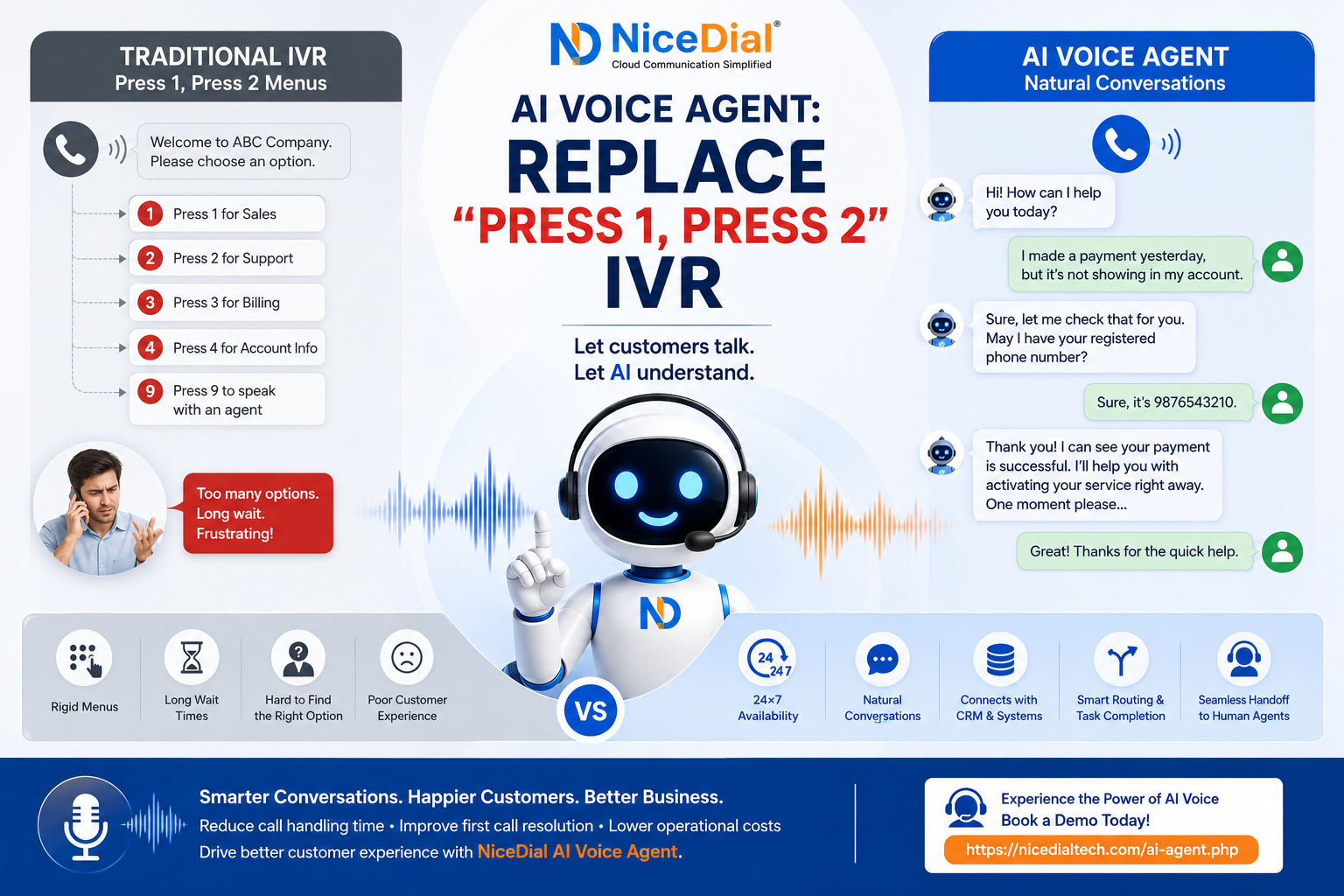
Press 1 for Sales.
Press 2 for Customer Support.
Press 3 for Billing.
Press 9 to speak with an agent.
For decades, this has been the standard experience when customers call businesses.
Traditional IVR (Interactive Voice Response) systems help organizations route large numbers of calls efficiently. But they also force customers to navigate predefined menus.
What if customers didn’t have to press anything?
Instead, imagine this:
AI Voice Agent:
Welcome to ABC Company. How can I help you today?
Customer:
I made a payment yesterday, but it’s still not showing in my account.
AI Voice Agent:
Sure. Let me check that for you.
That’s the difference between a traditional IVR menu and a modern AI Voice Agent.
AI-powered voice conversations can allow customers to simply say what they need, while the system understands their intent, retrieves relevant information, performs approved actions, or transfers the caller to the appropriate human agent.
What Is Traditional IVR?
IVR stands for Interactive Voice Response.
It allows callers to interact with an automated telephone system using keypad inputs or predefined voice commands.
A typical call might sound like:
“Welcome to XYZ Company.”
“For English, press 1.”
“For Hindi, press 2.”
“For Sales, press 1.”
“For Support, press 2.”
“For Billing, press 3.”
The caller navigates through a predefined decision tree until they reach the required department or action.
For predictable, high-volume workflows, this model can still work very well.
The problem begins when the customer’s requirement doesn’t fit neatly into the available menu.
The Problem With “Press 1, Press 2”
Imagine a customer calling because:
“My payment was deducted, but my service hasn’t been activated.”
Which option should they select?
Press 1 for Billing?
Press 2 for Technical Support?
Press 3 for Account Services?
The customer knows what the problem is.
The IVR doesn’t.
So instead of letting the customer explain the problem naturally, the system forces them to translate their requirement into the company’s menu structure.
That’s backwards.
With an AI Voice Agent, the customer can simply say:
“My payment was deducted but my service hasn’t started.”
The system can then determine what needs to happen next.
What Is an AI Voice Agent?
An AI Voice Agent is an AI-powered system capable of having spoken conversations with customers over the phone.
Instead of relying entirely on:
Press 1 → Press 2 → Press 4 → Wait for Agent
the experience can become:
Customer Speaks → AI Understands → AI Responds → AI Takes Action
A capable AI Voice Agent can potentially:
- Understand natural-language requests
- Identify customer intent
- Ask follow-up questions
- Handle interruptions
- Retrieve information from connected systems
- Call CRM or business APIs
- Perform approved actions
- Answer common questions
- Qualify leads
- Schedule appointments
- Route calls intelligently
- Transfer conversations to human agents with context
The customer doesn’t need to understand your internal departments or menu structure.
They simply explain what they need.
Traditional IVR vs AI Voice Agent
| Traditional IVR | AI Voice Agent |
|---|---|
| “Press 1, Press 2” menus | Natural conversations |
| Predefined decision trees | Flexible dialogue |
| Customer chooses department | AI understands intent |
| Limited follow-up capability | Can ask contextual questions |
| Difficult with unusual requests | Better suited to varied intents |
| Keypad-driven navigation | Voice-driven interaction |
| Transfers based on menu selection | Can transfer based on conversation |
| Limited system interaction | Can connect with CRM and APIs |
| Customer adapts to the system | System adapts to the conversation |
This doesn’t mean every IVR should disappear.
For simple, deterministic journeys, traditional flow-based automation may still be the better option.
But when customer requirements vary significantly, conversational AI becomes much more valuable.
How an AI Voice Agent Call Works
Consider a customer calling an insurance company.
Traditional IVR
IVR:
“For policy information, press 1.”
Customer presses 1.
IVR:
“For premium information, press 1. For policy status, press 2. For renewal, press 3.”
Customer presses 3.
IVR:
“Enter your 10-digit policy number.”
Several steps later, the customer may still need a human agent.
Now consider the same call with an AI Voice Agent.
AI Voice Agent
AI:
“Welcome. How can I help you?”
Customer:
“My car insurance expires next week. I want to know the renewal amount.”
AI:
“Sure. Let me help you check that.”
The AI Agent can then verify the customer using the approved process and retrieve the relevant information from connected systems.
One conversation replaces several layers of menu navigation.
AI Voice Agents Can Understand Intent
The important change isn’t simply replacing keypad input with speech.
Older voice systems could already recognize simple commands such as:
“Say Sales.”
“Say Support.”
“Say Billing.”
AI Voice Agents go further.
Customers might say:
“I need to change tomorrow’s appointment.”
or:
“Someone called me regarding a loan application.”
or:
“I haven’t received my order yet.”
or:
“I want to know whether my application was approved.”
The system can interpret the intent behind the sentence and determine which workflow or tool should be used.
Customers Can Interrupt and Ask Follow-Up Questions
Real conversations aren’t perfectly sequential.
Consider this interaction:
AI Agent:
“Your current outstanding amount is ₹—”
Customer:
“Wait. Does that include yesterday’s payment?”
A rigid voice flow may struggle because the customer has interrupted the expected sequence.
A conversational AI Agent can be designed to handle interruptions and follow-up questions while maintaining the context of the conversation.
That makes the interaction feel less like navigating software and more like speaking naturally.
AI Voice Agents Can Connect With CRM and Business Systems
Conversation alone isn’t enough.
Customers call businesses because they want something to happen.
They may want to:
- Check an application
- Reschedule an appointment
- Check an account balance
- Verify an order
- Request a callback
- Update information
- Book a service
- Find a payment status
An AI Voice Agent can be integrated with approved business systems and APIs.
For example:
Customer:
“Has my loan application been approved?”
The AI Agent could identify the customer, query the connected system, and provide an approved response.
Or:
Customer:
“I need to move my appointment from Monday to Wednesday.”
The AI Agent could check available slots and continue the rescheduling workflow.
This is where Voice AI moves beyond being a conversational FAQ system.
It becomes part of the business workflow.
AI Voice Agent for Lead Qualification
Voice AI can also be used for sales.
Imagine your company receives thousands of leads.
Instead of having salespeople manually call every lead just to collect basic information, an AI Voice Agent can perform the initial qualification.
For example:
AI Agent:
“Hi Rahul. You recently requested information about our cloud contact center solution. Is now a good time to speak?”
Customer:
“Yes.”
AI Agent:
“Great. Approximately how many agents would use the solution?”
Customer:
“About 50.”
AI Agent:
“Are you looking for inbound support, outbound calling, or both?”
The AI Agent can capture the answers and send qualified opportunities to the sales team.
The salesperson receives context instead of starting from zero.
AI Voice Agent for Appointment Booking
Appointment-driven businesses can also use conversational Voice AI.
For example:
Healthcare
“I need an appointment with Dr. Sharma tomorrow.”
Salon
“Can I book a haircut Saturday evening?”
Automobile Service
“I want to book my car service this weekend.”
Real Estate
“I’d like to visit the property on Sunday.”
The AI Agent can collect the required information and, when integrated with the relevant scheduling system, help complete the booking workflow.
AI Voice Agent for Customer Support
Many customer-support calls are repetitive.
Customers frequently call about:
- Order status
- Payment status
- Account information
- Service requests
- Appointment status
- Frequently asked questions
- Application status
- Callback requests
AI Voice Agents can handle suitable repetitive interactions while allowing human agents to focus on cases requiring judgment, empathy, negotiation, or specialized expertise.
What Happens When AI Doesn’t Know the Answer?
This is one of the most important questions when implementing an AI Voice Agent.
The AI should not simply invent an answer.
Businesses should define guardrails and escalation rules.
For example:
If information is available from an approved system → Answer
If an approved workflow exists → Execute it
If identity verification is required → Verify first
If confidence is insufficient → Ask for clarification
If the request is sensitive or outside scope → Transfer to human
A good AI implementation knows not only how to answer, but also when not to answer.
AI Can Transfer the Call With Context
Human agents remain essential.
But consider the difference between these two transfers.
Traditional Transfer
Agent:
“Hello. How can I help you?”
Customer:
“I’ve already explained this to your IVR…”
The customer starts again.
Contextual AI Transfer
The human agent receives:
Customer: Rahul Sharma
Intent: Payment issue
Problem: Payment completed yesterday but service not activated
Verification: Completed
Relevant Transaction: Identified
Reason for Transfer: Manual investigation required
The agent can start with:
“Rahul, I can see you’re calling about yesterday’s payment not reflecting. Let me check this further.”
That’s a very different customer experience.
AI Voice Agent + Traditional Voice Bot
Businesses don’t necessarily need to choose only one technology.
A hybrid model can often make more sense.
Use Scripted Voice Bot / IVR When:
- The workflow must be deterministic
- Compliance requires exact scripts
- Customer choices are predictable
- The journey is simple
- Very high-volume repetitive interactions need tight control
Use AI Voice Agent When:
- Customer questions vary significantly
- Natural dialogue is important
- Follow-up questions are common
- Multiple systems may need to be queried
- Intent cannot easily be predicted
- The conversation requires flexible reasoning
The two technologies can work together.
AI can handle the conversation and move the caller into a deterministic workflow when appropriate.
Industries That Can Use AI Voice Agents
Conversational Voice AI can be applied across many industries.
Banking & Fintech
Lead qualification, application status, payment reminders, customer enquiries.
Healthcare
Appointment booking, appointment rescheduling, reminders, patient enquiries.
Insurance
Policy enquiries, renewals, lead qualification, service requests.
Real Estate
Property enquiries, lead qualification, site-visit booking.
Automobile
Service booking, customer follow-up, insurance renewal, sales enquiries.
Education
Admission enquiries, counselling appointments, fee reminders.
Hotels & Restaurants
Reservations, customer enquiries, booking confirmations.
E-commerce
Order enquiries, delivery status, callback requests.
Contact Centers
Inbound automation, outbound campaigns, customer verification, intelligent call routing.
Benefits of Replacing Menu-Heavy IVR With Conversational AI
1. More Natural Customer Experience
Customers explain what they need instead of navigating complicated menus.
2. Faster Intent Identification
The AI can identify the reason for the call from the conversation.
3. 24×7 Availability
Suitable automated conversations can continue outside normal business hours.
4. Reduced Repetitive Work
Human agents spend less time handling basic, repetitive enquiries.
5. Better Call Routing
Calls can be routed according to customer intent rather than only keypad selections.
6. Contextual Human Handoff
Agents can receive conversation context when escalation is required.
7. Scalable Customer Engagement
Businesses can automate suitable conversations without increasing human-agent capacity at exactly the same rate as call volume.
Don’t Just Replace IVR — Redesign the Customer Journey
Moving to Voice AI shouldn’t simply mean:
Old IVR + AI Voice
Businesses should reconsider the entire customer journey.
Ask:
Why is the customer calling?
Which information can AI safely provide?
Which actions can AI perform?
Which systems need integration?
When should a human take over?
Which conversations should remain deterministic?
The goal isn’t to use AI everywhere.
The goal is to use the right automation for the right conversation.
NiceDial AI Agent: From Menu Trees to Conversations
NiceDial AI Agent is designed for scenarios where customers need more flexibility than a traditional scripted voice journey.
NiceDial’s streaming AI approach supports natural dialogue, interruptions and follow-up questions, connected tool lookups, configurable guardrails, and warm transfer to human agents when necessary.
For deterministic, high-volume journeys, businesses can continue using a scripted Voice Bot.
For open conversations and multi-step requirements, they can use an AI Agent.
That creates a hybrid architecture:
Cloud Telephony → Voice Bot / AI Agent → CRM & APIs → Human Agent
Instead of forcing every customer into the same automation model, businesses can choose the appropriate experience for each use case.
Stop Making Customers Press Their Way Through Your Business
Customers already know why they’re calling.
Let them say it.
Instead of:
“Press 1 for Sales.”
“Press 2 for Support.”
“Press 3 for Billing.”
Imagine starting every call with:
“How can I help you today?”
That’s the opportunity conversational Voice AI creates.
🚀 Explore NiceDial AI Agent
See how NiceDial can help you combine AI Voice Agents, Voice Bots, Cloud Telephony, CRM integrations, and human agents into a modern customer communication experience.
👉 Request a Technical Walkthrough:
https://nicedialtech.com/ai-agent.php
Let customers talk naturally. Let AI understand. Bring humans in when they matter most.