A customer calls your business at 11:45 PM.
Your contact center is closed.
Your sales team has gone home.
But the customer still needs help.
Maybe they want to:
- Check an appointment
- Ask about a product
- Know their application status
- Schedule a service
- Request a callback
- Check a payment
- Speak about an existing order
Traditionally, the customer hears:
“Our business hours are 9 AM to 6 PM. Please call again during working hours.”
Or the call goes to voicemail.
An AI Voice Agent offers another option.
Instead of making the customer wait, an AI Voice Agent can answer the call, understand why the customer is calling, conduct a natural conversation, retrieve information from connected systems, perform approved actions, and escalate the interaction when human assistance is required.
This allows businesses to provide automated voice assistance 24 hours a day, 7 days a week without expecting human agents to remain available around the clock.
What Is an AI Voice Agent?
An AI Voice Agent is an AI-powered system designed to communicate with customers over telephone calls using natural spoken conversations.
Traditional IVR systems typically ask customers to navigate menus:
“Press 1 for Sales.”
“Press 2 for Support.”
“Press 3 for Billing.”
An AI Voice Agent can instead begin with:
“Hello. How can I help you today?”
The customer can explain their requirement naturally.
For example:
Customer:
“I have an appointment tomorrow, but I need to move it to Friday.”
AI Voice Agent:
“Sure. I can help you with that. May I first verify your registered mobile number?”
The conversation can then continue based on the customer’s response and the business workflow.
How Does an AI Voice Agent Handle a Customer Call?
A typical AI-powered call can follow this journey:
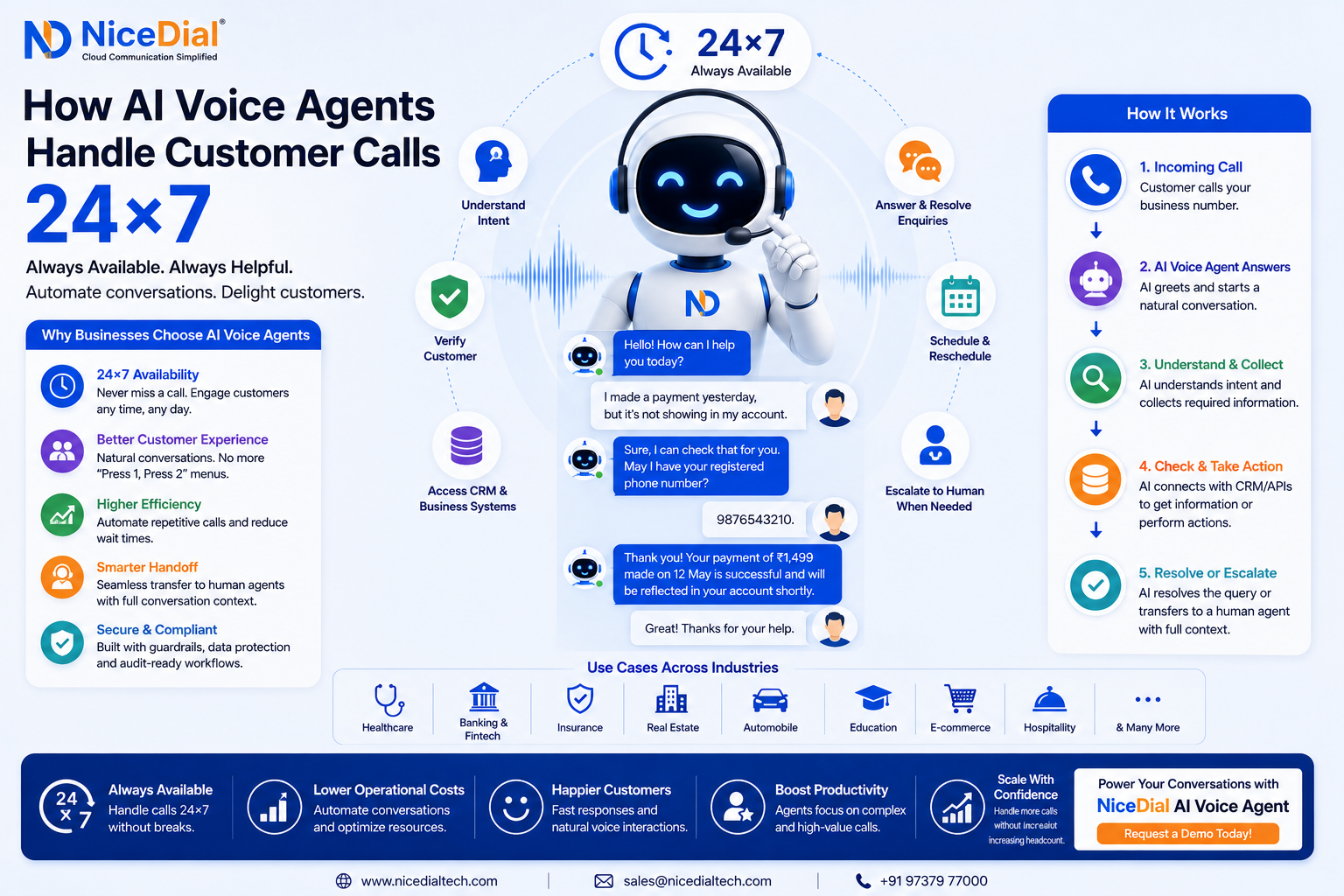
Incoming Call → AI Answers → Understand Intent → Verify Customer → Check Business System → Take Action → Confirm → Resolve or Transfer
Let’s look at each stage.
1. AI Answers the Call Instantly
When a customer calls, the telephony platform routes the call to the AI Voice Agent.
Instead of waiting in a queue simply to explain why they’re calling, the customer can immediately begin interacting with the AI.
For example:
AI Voice Agent:
“Welcome to ABC Healthcare. How can I help you today?”
Customer:
“I need to change tomorrow’s doctor appointment.”
The AI now has an initial indication of the customer’s intent.
2. AI Understands Why the Customer Is Calling
This is one of the biggest differences between conversational Voice AI and traditional menu-based IVR.
Customers don’t always describe the same requirement using identical words.
One customer might say:
“I want to change my appointment.”
Another:
“I can’t come tomorrow.”
Another:
“Can you move my doctor appointment to Saturday?”
All three customers may have the same underlying intent:
Appointment Rescheduling
An AI Voice Agent can use the conversation to determine the likely intent rather than forcing every caller through the same menu structure.
3. AI Asks Follow-Up Questions
Understanding the initial request may not be enough.
The AI Voice Agent may need additional information.
For example:
Customer:
“I want to reschedule my appointment.”
AI:
“Sure. Which day would you prefer?”
Customer:
“Friday evening.”
AI:
“Let me check the available slots.”
The AI can maintain conversation context while collecting the information required to complete the workflow.
This is important because real customer conversations rarely follow a perfect script.
4. AI Can Verify the Customer
Some workflows require customer verification before information can be disclosed or an action can be performed.
Depending on the business and use case, verification could involve information such as:
- Registered mobile number
- Customer ID
- Application number
- Appointment reference
- Order number
- OTP or another approved verification method
The verification requirements should be defined according to the organization’s security, privacy, and compliance policies.
Once verification is completed, the AI can continue with the appropriate authorized workflow.
5. AI Connects With CRM, APIs and Business Systems
An AI Voice Agent becomes much more useful when it can securely interact with the systems that actually contain customer information.
These could include:
- CRM
- Appointment system
- Customer database
- Helpdesk
- Order management system
- Loan management system
- Hospital management system
- ERP
- Ticketing platform
- Custom business APIs
Consider this conversation:
Customer:
“What is the status of my application?”
Instead of simply saying:
“Our team will contact you.”
the AI Agent can potentially query an approved API.
The workflow becomes:
Customer Question → AI Understands → API Lookup → Business System Responds → AI Explains Result
This turns the AI from a voice FAQ system into an active part of the customer-service workflow.
6. AI Can Perform Approved Actions
Customer service isn’t only about providing information.
Customers often call because they need something done.
An AI Voice Agent can be connected to workflows that allow approved actions such as:
- Book an appointment
- Reschedule an appointment
- Create a service request
- Register a callback
- Update a CRM record
- Create a support ticket
- Capture a sales enquiry
- Qualify a lead
- Record customer preferences
- Trigger an approved notification
For example:
Customer:
“Can you move my appointment to Friday?”
AI:
“I can see an available slot at 4:30 PM on Friday. Would that work?”
Customer:
“Yes.”
AI:
“Your appointment has been rescheduled to Friday at 4:30 PM.”
One conversation can potentially complete the entire workflow.
7. AI Handles Interruptions and Follow-Up Questions
Human conversations aren’t linear.
Imagine:
AI:
“Your appointment is scheduled for Monday at—”
Customer:
“Wait, is Dr. Sharma available on Tuesday instead?”
A rigid voice flow may have difficulty when the caller interrupts the expected sequence.
Conversational AI can be designed to recognize interruptions, retain relevant context, and continue the conversation.
This creates a more natural experience than forcing callers to wait for every prompt to finish.
What Happens When the AI Cannot Resolve the Call?
A good AI Voice Agent shouldn’t pretend to know everything.
There should always be clear guardrails.
A useful model is:
AI knows + authorized → Respond
AI can perform approved action → Execute
More information required → Ask
Uncertain → Clarify
Outside AI scope → Escalate
Sensitive or complex situation → Human Agent
The ability to recognize when human assistance is required is just as important as the ability to automate.
AI-to-Human Call Transfer
Suppose a customer calls about a complicated billing issue.
The AI gathers the initial information but determines that manual investigation is required.
Instead of simply transferring the call, the system can potentially provide context to the human agent.
Customer Context
Customer: Rahul Sharma
Reason for Call: Payment issue
Issue: Payment completed but service not activated
Verification: Completed
Actions Already Taken: Payment status checked
Reason for Transfer: Manual investigation required
Now the human agent doesn’t have to start with:
“Hello. How can I help you?”
They can begin with:
“Rahul, I understand you’re calling because your payment has been completed but your service hasn’t been activated. Let me investigate this further.”
This can make the transition from AI to human support much smoother.
How Can AI Voice Agents Work 24×7?
Human contact centers have practical limitations.
They require:
- Agent shifts
- Supervisors
- Break management
- Night staffing
- Holiday staffing
- Workforce planning
An AI Voice Agent is software.
Once deployed on suitable infrastructure and connected to telephony and business systems, it can be available outside normal business hours.
That makes it particularly useful for:
After-hours calls
Weekend enquiries
Holiday enquiries
Overflow calls
Peak-hour traffic
Routine 24×7 customer requests
Human teams can then concentrate on interactions that require their expertise.
Example: Healthcare AI Voice Agent at 2 AM
Imagine a patient calls a hospital at 2 AM.
AI:
“Welcome to ABC Hospital. How can I help you?”
Patient:
“I have an appointment tomorrow morning. I need to cancel it.”
AI:
“Sure. I can help with your appointment. May I verify your registered mobile number?”
After verification, the AI can query the appointment system.
AI:
“I found your appointment with Dr. Sharma tomorrow at 10:30 AM. Would you like to cancel it or reschedule?”
Patient:
“Reschedule it.”
The AI can continue the approved scheduling workflow.
The hospital didn’t need a receptionist awake at 2 AM simply to handle this routine request.
Example: AI Voice Agent for Sales Enquiries
Now imagine a potential customer calls at 9:30 PM after seeing an advertisement.
AI:
“Welcome to ABC Company. How can I help you?”
Customer:
“I’m looking for a cloud contact center for around 50 agents.”
The AI can collect initial qualification information:
- Company name
- Number of agents
- Inbound/outbound requirement
- Existing CRM
- Implementation timeline
- Preferred demo time
The lead can then be recorded in the CRM and routed to the sales team.
Instead of receiving only:
Missed Call: 98XXXXXXXX
the sales team can receive:
New Qualified Enquiry
Requirement: Cloud Contact Center
Agents: 50
Channels: Voice
CRM Integration: Required
Timeline: Within 30 days
Demo: Interested
That’s a much more useful starting point.
AI Voice Agents for Different Industries
Healthcare
AI Voice Agents can assist with:
- Appointment booking
- Appointment rescheduling
- Appointment reminders
- Basic patient enquiries
- Callback requests
Banking & Fintech
Potential workflows include:
- Lead qualification
- Application enquiries
- Customer verification
- Payment reminders
- Callback scheduling
Insurance
AI can support:
- Renewal enquiries
- Policy-related FAQs
- Lead qualification
- Customer follow-ups
- Service-request routing
Automobile
Potential use cases include:
- Vehicle service booking
- Service reminders
- Customer follow-up
- Sales enquiries
- Test-drive requests
Real Estate
AI Voice Agents can help:
- Qualify property enquiries
- Collect budget requirements
- Understand location preferences
- Schedule site visits
- Follow up with leads
Education
Use cases can include:
- Admission enquiries
- Course information
- Counselling scheduling
- Student follow-ups
- Fee reminders
Hotels & Restaurants
Voice AI can help handle:
- Reservation enquiries
- Booking requests
- Frequently asked questions
- Customer callbacks
AI Voice Agent vs Human Agent
AI and human agents have different strengths.
| AI Voice Agent | Human Agent |
|---|---|
| Available 24×7 | Works scheduled shifts |
| Handles repetitive calls consistently | Handles nuanced situations |
| Can process routine enquiries | Uses judgment and empathy |
| Can perform connected workflows | Handles exceptions |
| Scales for predictable automation | Builds deeper relationships |
| Can gather information before transfer | Handles negotiation and complex decisions |
The goal shouldn’t be:
AI OR Humans
A stronger strategy is:
AI + Human Agents
AI handles repetitive and predictable conversations.
Humans handle complex and high-value conversations.
AI Voice Agent vs Traditional IVR
Traditional IVR:
“Press 1 for Sales.”
“Press 2 for Support.”
“Press 3 for Billing.”
AI Voice Agent:
“How can I help you?”
The customer simply explains their requirement.
This is a fundamental shift from:
Menu Navigation
to:
Conversation-Based Customer Service
Traditional IVR can still be valuable for simple and deterministic workflows.
AI Voice Agents become particularly useful where callers have varied requirements, ask follow-up questions, or need information from multiple systems.
Benefits of 24×7 AI Voice Agents
Always Available
Routine customer conversations don’t have to stop when the office closes.
Faster Response
Customers can receive immediate assistance rather than waiting for the next working day.
Reduced Call Queues
Suitable repetitive calls can be handled automatically.
Better Agent Productivity
Human agents can spend more time on interactions requiring expertise.
Consistent Customer Experience
Approved workflows and business rules can be applied consistently.
Improved Lead Capture
After-hours sales calls don’t necessarily become missed opportunities.
Scalable Operations
Businesses can automate appropriate call volumes without expanding human staffing at exactly the same rate.
Important: 24×7 Doesn’t Mean AI Should Handle Everything
Businesses shouldn’t automate a conversation simply because AI technically can.
Some interactions require humans.
Examples might include:
- Complex complaints
- Sensitive customer situations
- High-value negotiations
- Unusual exceptions
- Requests outside approved policies
- Situations requiring human judgment
Businesses should therefore define:
What AI can answer
What AI can access
What AI can change
What requires verification
What requires human approval
When the call must be transferred
Guardrails are a core part of a production AI Voice Agent.
NiceDial AI Voice Agent
NiceDial AI Agent is designed for businesses that want to move beyond rigid voice menus and build more conversational customer interactions.
NiceDial’s AI Agent approach can support:
- Natural voice conversations
- Customer interruptions
- Follow-up questions
- Multi-step interactions
- CRM and API integrations
- Business-system lookups
- Configurable guardrails
- Human-agent escalation
Businesses can combine AI Agents with NiceDial Cloud Telephony, contact-center workflows, CRM integrations, Voice Bots, and human agents to build a complete communication architecture.
A typical deployment could look like:
Customer Call
↓
↓
AI Voice Agent
↓
Understand Customer Intent
↓
CRM / API / Business System
↓
Resolve Automatically OR Transfer to Human Agent
Your Customers Don’t Stop Calling When Your Office Closes
Customer expectations have changed.
Someone may need assistance at:
10 PM
2 AM
Sunday afternoon
During a public holiday
Businesses don’t necessarily need a full human team available every minute to handle every routine interaction.
AI Voice Agents provide another layer of customer availability.
Let AI handle the conversations it can safely automate.
Let your business systems provide the information.
And let your human team take over when judgment, expertise, and relationships matter.
Turn Every Call Into a Conversation
Don’t make every customer wait for business hours.
Don’t make every caller navigate:
“Press 1, Press 2, Press 3…”
Start with a simpler question:
“How can I help you today?”
🚀 Explore NiceDial AI Agent
Discover how NiceDial AI Voice Agents can help automate customer conversations and connect Voice AI with your existing telephony, CRM, APIs, and human agents.
👉 Request a Demo / Technical Walkthrough:
https://nicedialtech.com/ai-agent.php
Let AI answer. Let customers talk naturally. Keep your business available 24×7.
Frequently Asked Questions
What is an AI Voice Agent?
An AI Voice Agent is an AI-powered system that communicates with customers through natural spoken conversations over telephone calls. It can understand customer intent, ask follow-up questions, interact with connected systems, perform approved actions, and escalate calls when necessary.
Can an AI Voice Agent answer calls 24×7?
An AI Voice Agent can be configured to remain available around the clock, subject to the availability of the telephony platform, integrations, infrastructure, and business systems it depends on.
Can AI Voice Agents transfer calls to humans?
Yes. A Voice AI workflow can be designed to transfer a call when the customer’s requirement needs human assistance. Relevant conversation context can also be provided to the human agent.
Can an AI Voice Agent connect with CRM software?
Yes. AI Voice Agents can be integrated with CRM platforms and other business systems through supported APIs and integrations, subject to the capabilities and permissions of those systems.
Can AI Voice Agents make outbound calls?
Yes. Voice AI can also support suitable outbound use cases such as lead qualification, reminders, follow-ups, appointment confirmations, and customer callbacks, subject to applicable consent, telecom, and communication regulations.
Is an AI Voice Agent better than IVR?
It depends on the workflow. Traditional IVR remains effective for simple, deterministic processes. AI Voice Agents are particularly useful when customers need natural conversations, ask varied questions, or require contextual interactions.