Hospitals receive hundreds or even thousands of patient enquiries every day.
Patients call to ask:
- Is Dr. Sharma available today?
- I want to book an appointment.
- Can I reschedule tomorrow’s appointment?
- Which department should I visit?
- What time does the OPD start?
- Where is the hospital located?
- Can someone call me back?
- Is my appointment confirmed?
Many of these questions are repetitive, but every enquiry still requires attention.
During peak hours, reception desks and hospital call centers can become overloaded. After business hours, patients may have to wait until the next day for non-emergency assistance.
An AI Agent for hospitals can help automate suitable patient enquiries through voice and digital channels, while transferring conversations to hospital staff when human assistance is required.
The goal is not to replace hospital staff.
It is to let AI handle routine administrative conversations so healthcare teams can focus on interactions where people are needed most.
What Is an AI Agent for Hospitals?
A hospital AI Agent is a conversational system configured around approved hospital information and workflows.
Instead of forcing patients through complicated menus, an AI Voice Agent can begin with a simple question:
“Welcome to ABC Hospital. How can I help you today?”
The patient can respond naturally:
Patient:
“I need an appointment with a cardiologist tomorrow.”
The AI can then ask:
AI Agent:
“Sure. Do you have a preferred doctor, or would you like me to check available cardiologists?”
When connected with the hospital’s appointment system, the AI can potentially check availability and continue the booking process.
A typical workflow could be:
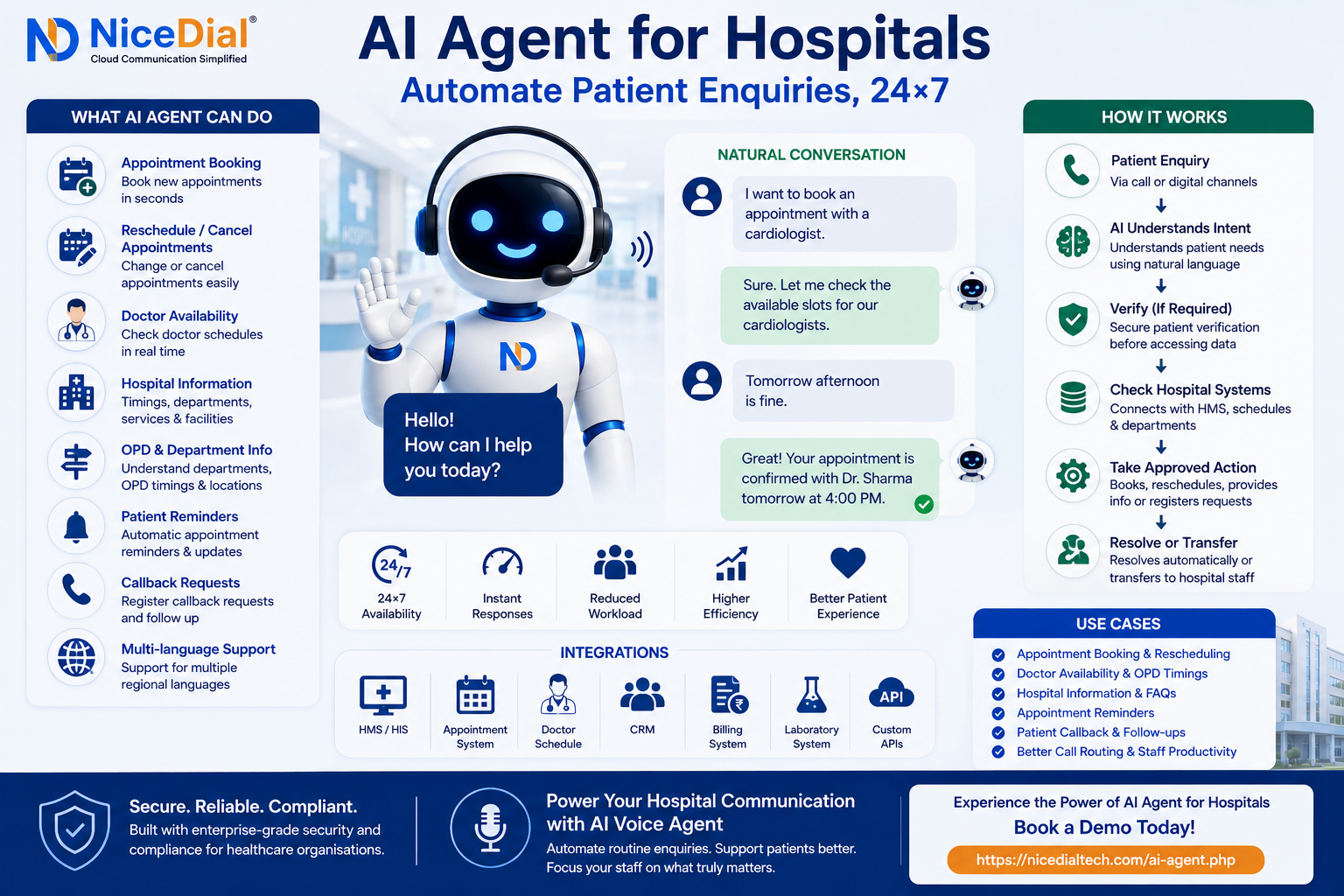
Patient Enquiry → AI Understands Intent → Collects Required Information → Checks Hospital System → Takes Approved Action → Confirms or Transfers to Staff
Why Hospitals Need Better Patient-Enquiry Automation
A hospital reception team handles much more than answering phones.
Staff may simultaneously be managing:
- Walk-in patients
- Appointment bookings
- Doctor schedules
- Patient registrations
- Billing enquiries
- Internal coordination
- Calls from existing patients
- Calls from new patients
- Follow-ups
- Administrative work
Now imagine receiving another call:
“What time does the dermatology OPD start?”
The question is important to the patient, but answering hundreds of similar questions manually consumes staff time.
AI can provide an additional layer of automation for these repetitive interactions.
1. Automate Appointment Enquiries
Appointment-related questions are among the most common hospital enquiries.
Patients may ask:
“Is Dr. Gupta available tomorrow?”
“Can I get an appointment after 5 PM?”
“Which doctor should I contact for an eye check-up?”
“I need to see an orthopedic doctor.”
An AI Agent can collect the required information and, when integrated with the hospital’s scheduling system, check relevant appointment availability.
The journey can become:
Patient Calls → AI Understands Department/Doctor → Checks Schedule → Offers Available Options → Patient Selects → Appointment Created
This can reduce the number of routine appointment calls requiring manual receptionist involvement.
2. Appointment Rescheduling
Patients frequently need to change existing appointments.
Traditionally:
Patient Calls → Receptionist Answers → Patient Details Collected → Appointment Located → New Slot Checked → Appointment Changed
An AI-powered workflow can automate suitable parts of this process.
For example:
Patient:
“I have an appointment tomorrow, but I can’t come.”
AI Agent:
“I can help you with that. Would you like to cancel the appointment or reschedule it?”
Patient:
“Reschedule.”
AI Agent:
“Which day would you prefer?”
After appropriate verification, the AI can query the appointment system and offer available options.
3. Handle Doctor Availability Enquiries
A large number of calls may simply be:
“Is Dr. Sharma available today?”
If doctor schedules are available through an approved hospital system or API, the AI Agent can retrieve the information.
For example:
Patient:
“Is Dr. Mehta available tomorrow evening?”
AI Agent:
“Let me check the available schedule.”
Instead of requiring hospital staff to manually look up the same information repeatedly, the AI can perform the lookup automatically.
4. Answer Common Hospital FAQs
Not every patient enquiry requires access to medical records.
Many questions are administrative.
An AI Agent can be configured with approved information such as:
Hospital Timings
“What time does the hospital open?”
OPD Timings
“When does the cardiology OPD start?”
Location
“How do I reach the hospital?”
Departments
“Do you have a neurology department?”
Facilities
“Is parking available?”
Appointment Process
“Do I need an appointment before visiting?”
Contact Information
“How can I contact the billing department?”
Automating these questions can significantly reduce repetitive calls reaching reception staff.
5. Help Patients Reach the Right Department
Traditional hospital IVR may say:
“Press 1 for Appointments.”
“Press 2 for Billing.”
“Press 3 for Diagnostics.”
“Press 4 for Pharmacy.”
But patients may not always know which department they need.
An AI Voice Agent can instead ask:
“How can I help you?”
A patient might say:
“I need to change my appointment.”
The AI understands:
Intent: Appointment Rescheduling
Another patient might say:
“I have a question about my bill.”
The AI identifies:
Intent: Billing Enquiry
The call can then be handled through the appropriate workflow or transferred to the relevant department.
6. Provide 24×7 Assistance for Routine Enquiries
Patients don’t only have questions between 9 AM and 6 PM.
Someone may call at 11 PM because they want to know whether their appointment tomorrow is confirmed.
Another patient may want to reschedule an appointment before going to sleep.
Another may want to know the hospital’s location before travelling the next morning.
An AI Agent can provide automated assistance for suitable administrative enquiries outside normal reception hours.
However, an important distinction must be made:
AI administrative support is not emergency medical care.
Hospitals should configure clear emergency messaging and routing.
For example:
“If this is a medical emergency, please contact your local emergency service or follow the hospital’s emergency-care instructions.”
AI should not delay emergency care by attempting to conduct routine automation when urgent medical attention may be required.
7. AI Agent + Hospital Management System
The real power of hospital AI automation comes from integration.
An AI Agent can potentially connect with:
- Hospital Management System (HMS)
- Hospital Information System (HIS)
- Appointment management system
- CRM
- Patient registration system
- Helpdesk
- Doctor scheduling system
- Laboratory systems where appropriate
- Custom hospital APIs
This enables conversations to become workflows.
For example:
Patient:
“I want to know whether tomorrow’s appointment is confirmed.”
The system could follow:
Understand Request → Verify Patient → Check Appointment API → Retrieve Status → Provide Approved Response
Without integration, AI primarily provides information.
With integration, AI can potentially perform approved administrative tasks.
8. AI Agent for Appointment Reminders
Hospitals can also use automated voice workflows for outbound patient communication.
Before an appointment, an AI Voice Agent can contact the patient:
AI Agent:
“Hello. This is an appointment reminder from ABC Hospital. You have an appointment with Dr. Sharma tomorrow at 11 AM. Will you be able to attend?”
The patient might say:
“No, I need to change it.”
Instead of ending the interaction, the AI can potentially move into the approved rescheduling workflow.
This creates a more interactive process than a simple recorded reminder.
9. Reduce Missed Appointments
Missed appointments create problems for both patients and hospitals.
A patient may forget.
Plans may change.
The patient may intend to reschedule but never contact the hospital.
Conversational reminders can allow patients to respond immediately.
Appointment Reminder → Patient Confirms → Done
or
Appointment Reminder → Patient Cannot Attend → Rescheduling Workflow
This gives hospitals an opportunity to manage appointment changes earlier.
10. Handle Multiple Languages
Hospitals often serve patients who are more comfortable speaking in different languages.
Depending on the deployed speech and language technologies, AI Agents can be configured for multilingual conversations.
For example, a hospital serving patients across India may need support for languages such as:
Hindi, English, Tamil, Telugu, Kannada or Marathi.
The exact language support should be validated for the specific deployment, voice model and workflow.
Multilingual AI can make automated hospital interactions more accessible to a wider patient base.
11. Transfer Complex Conversations to Hospital Staff
AI should not attempt to automate every patient interaction.
Consider:
Patient:
“I don’t understand the charges on my final bill.”
or:
Patient:
“I need help regarding a complicated insurance approval.”
or a situation involving medical advice.
These may require human involvement.
The AI Agent can transfer the conversation to an appropriate staff member.
Even better, it can provide context.
Instead of the staff member receiving:
Incoming Patient Call
they could receive:
Patient: Rahul Sharma
Reason: Billing enquiry
Verification: Completed
Issue: Question about discharge bill
AI Action: Basic billing information provided
Transfer Reason: Detailed explanation required
The hospital representative can continue from the existing conversation rather than asking the patient to start again.
12. AI Agent for Hospital Call Centers
Large hospitals and hospital groups may operate centralized contact centers.
AI Voice Agents can become the first automation layer for suitable calls.
For example:
Incoming Patient Calls
↓
↓
AI Voice Agent
↓
Understand Patient Requirement
↓
HMS / CRM / Appointment API
↓
Resolve Automatically
OR
↓
Transfer to Hospital Agent
This can allow routine interactions to be automated while the existing contact-center team remains available for more complex enquiries.
AI Agent vs Traditional Hospital IVR
| Traditional Hospital IVR | Hospital AI Agent |
|---|---|
| Press 1, Press 2 menus | Natural conversation |
| Patient chooses department | AI identifies intent |
| Predefined menu structure | Contextual conversation |
| Limited follow-up | Can ask relevant questions |
| Primarily call routing | Can support workflows |
| Fixed options | Handles varied expressions |
| Menu-based transfer | Intent-based handoff |
| Limited context | Can provide context to staff |
| Basic automation | Can connect with HMS/CRM/APIs |
Traditional IVR can still be useful for predictable journeys.
AI Agents become valuable when patients need more flexible conversations.
AI Agent vs Hospital Receptionist
AI and hospital staff have very different roles.
AI Agent Can Help With:
- Routine FAQs
- Appointment enquiries
- Appointment booking workflows
- Appointment rescheduling
- Appointment reminders
- Doctor availability lookups
- Department routing
- Callback requests
- Administrative information
Hospital Staff Should Handle:
- Medical advice and clinical decisions
- Complex patient situations
- Sensitive conversations
- Complaints requiring judgment
- Billing disputes
- Exceptions
- Cases requiring empathy
- Emergency situations according to hospital protocols
The strategy should therefore be:
AI + Hospital Staff
Not:
AI vs Hospital Staff
Patient Privacy and Security Matter
Healthcare automation requires careful handling of patient information.
Hospitals implementing AI Agents should consider:
- Authentication and verification
- Role-based access
- Data minimization
- Access logging
- Encryption
- API permissions
- Data-retention policies
- Consent requirements
- Applicable healthcare and privacy regulations
- Human escalation procedures
The AI Agent should only access the information required for the approved workflow.
For sensitive healthcare data, security and governance should be designed into the implementation from the beginning.
Example: Complete Hospital AI Agent Journey
Imagine a patient calls at 10:30 PM.
AI Agent:
“Welcome to ABC Hospital. How can I help you?”
Patient:
“I have an appointment with Dr. Sharma tomorrow, but I can’t come.”
AI Agent:
“Sure. Would you like to cancel the appointment or reschedule it?”
Patient:
“Reschedule.”
After appropriate verification:
AI Agent:
“Which day would you prefer?”
Patient:
“Saturday morning.”
The AI checks the connected scheduling system.
AI Agent:
“An appointment is available at 10:30 AM on Saturday. Would you like me to book it?”
Patient:
“Yes.”
AI Agent:
“Your appointment has been rescheduled to Saturday at 10:30 AM.”
The entire routine interaction can potentially be completed without waiting for the reception desk to reopen.
Benefits of AI Agents for Hospitals
24×7 Administrative Assistance
Patients can access suitable automated services outside regular reception hours.
Reduced Reception Workload
Routine questions can be handled without requiring staff involvement every time.
Faster Patient Response
Patients don’t necessarily have to wait in a call queue for simple requests.
Better Appointment Management
Booking, confirmation, reminders and rescheduling can become part of connected workflows.
Multilingual Engagement
Hospitals can potentially provide conversational assistance across multiple supported languages.
Better Call Routing
AI can understand why a patient is calling before determining the appropriate department.
Contextual Human Handoff
Hospital staff can receive information about the conversation before taking over.
Scalable Patient Communication
Hospitals can handle larger volumes of routine enquiries without increasing receptionist capacity at exactly the same rate.
Where NiceDial AI Agent Fits
NiceDial AI Agent can be used to build conversational workflows for organizations that need more flexibility than traditional menu-based automation.
For hospitals, potential workflows include:
- Patient enquiry automation
- Appointment booking
- Appointment rescheduling
- Appointment reminders
- Doctor availability enquiries
- Department routing
- Patient callbacks
- Multilingual voice interactions
- HMS/CRM/API integration
- Human-agent escalation
Combined with NiceDial Cloud Telephony, the architecture can bring together:
Patient → Cloud Telephony → AI Voice Agent → HMS/CRM/API → Resolution or Hospital Staff
Don’t Make Every Patient Enquiry Wait for Reception
A patient asking:
“Can I move tomorrow’s appointment?”
doesn’t necessarily need to wait in a call queue.
A patient asking:
“Is the cardiology OPD available tomorrow?”
may not require a receptionist to manually answer the question.
And a patient calling at 10 PM shouldn’t necessarily have to wait until morning for a routine administrative request.
This is where AI Agents can help hospitals rethink patient communication.
Let AI handle suitable repetitive enquiries.
Let hospital systems provide approved information.
Let hospital staff focus on conversations where human expertise matters.
🚀 Explore NiceDial AI Agent for Hospital Automation
Discover how NiceDial can help connect AI Voice Agents, Cloud Telephony, appointment workflows, HMS/CRM systems and human hospital teams.
Request a NiceDial AI Agent demo
Automate routine patient enquiries. Keep humans available where patients need them most.
Frequently Asked Questions
Can an AI Agent book hospital appointments?
Yes, when the AI Agent is integrated with an appropriate appointment-management system and given the required permissions, it can support approved booking workflows.
Can an AI Agent reschedule appointments?
Yes. The AI can collect the patient’s request, perform appropriate verification, check available slots through an integrated system, and support the approved rescheduling process.
Can a hospital AI Agent work 24×7?
It can be configured for round-the-clock availability, subject to the availability of the telephony infrastructure, AI services and connected hospital systems.
Can an AI Agent provide medical advice?
Routine administrative automation should be clearly separated from clinical decision-making. Medical advice, diagnosis, treatment decisions, emergencies and other clinical matters should follow the hospital’s appropriate clinical and human-care protocols.
Can AI transfer a patient to hospital staff?
Yes. AI workflows can escalate calls when human assistance is needed and can provide relevant conversation context to the receiving team.
Can AI Agents integrate with hospital software?
They can integrate with hospital systems that provide suitable APIs or other supported integration methods, subject to security, permissions and the capabilities of those systems.