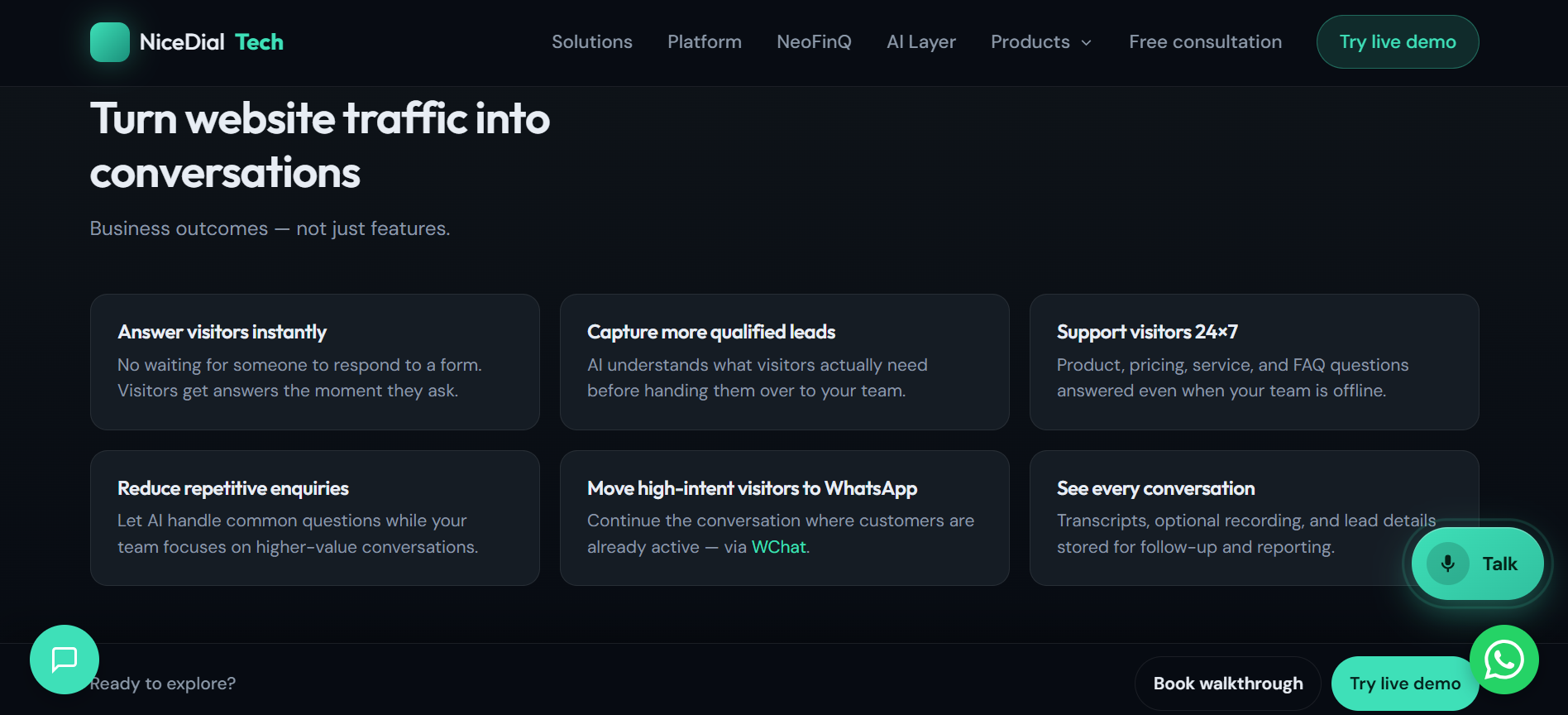
For years, businesses have used chatbots to answer common questions, collect contact information,, and guide website visitors.
Most traditional chatbots, however, follow a predefined path:
Visitor clicks → selects an option → follows a menu → fills a form → waits for the next step.
Conversational AI is changing this experience.
Instead of forcing visitors through predefined menus, an AI website assistant can understand natural questions, use business-specific knowledge to generate relevant answers, and help move the conversation toward the visitor’s actual requirement.
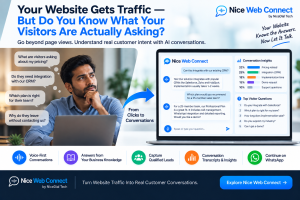
This is the idea behind Nice Web Connect, a Website Conversational AI Platform from NiceDial Technology.
What Is a Traditional Website Chatbot?
A traditional chatbot generally works using predefined rules, buttons, keywords, or decision trees.
For example, a visitor might see:
How can we help you?
- Sales
- Support
- Pricing
- Book a Demo
If the visitor chooses Pricing, the chatbot follows the flow configured for that option.
This approach can work well for predictable enquiries.
The limitation appears when visitors ask questions that don’t perfectly match the predefined flow.
Someone may want to ask:
“We have a 50-agent customer support team. Which solution would be suitable for us?”
A traditional rule-based chatbot may struggle unless that specific journey has already been configured.
What Is a Conversational AI Website Assistant?
A conversational AI assistant works differently.
Instead of requiring the visitor to understand your menu structure, it allows them to explain what they need naturally.
The visitor could ask:
“Do you have a solution for managing calls for 50 customer support agents?”
or:
“Can this integrate with our existing CRM?”
or:
“Can someone send me the details on WhatsApp?”
The AI interprets the visitor’s intent and responds conversationally.
With Nice Web Connect, the experience can also be voice-first, allowing visitors to speak directly with the website from their browser.
Traditional Chatbot vs Conversational AI
| Capability | Traditional Chatbot | Conversational AI |
|---|---|---|
| Interaction | Buttons / predefined flows | Natural conversation |
| Questions | Expected questions | Flexible questions |
| Voice conversation | Usually no | Yes |
| Knowledge | Manually configured flows | Business knowledge |
| Website content grounding | Limited | Yes |
| Understand visitor intent | Basic | Advanced |
| Lead qualification | Form/flow based | Conversation based |
| WhatsApp continuation | Separate integration | Can be integrated |
| 24×7 assistance | Yes | Yes |
| Human handoff | Possible | Possible with conversation context |
The objective isn’t necessarily to eliminate traditional chat.
It is to give website visitors another, more natural way to interact with a business.
The Important Difference: Knowledge Grounding
One of the most important concepts behind a business AI assistant is knowledge grounding.
A generic AI model knows a great deal about general topics.
But your customers don’t primarily need generic information.
They need information about your business.
They might want to know:
- Which products you offer
- How your service works
- Pricing or plan information
- Product specifications
- Business policies
- Appointment availability
- Service areas
- Integration capabilities
- Frequently asked questions
This is why business-specific knowledge matters.
Nice Web Connect can be grounded on controlled sources such as:
Website Content → FAQs → PDFs/Documents → Products → APIs/Data Sources → Custom Knowledge
The objective is simple:
Answer from approved business knowledge rather than relying on generic internet information.
This makes conversational AI considerably more useful for customer-facing applications.
Your Website Already Contains Valuable Knowledge
Think about how much information already exists on a typical company website.
There may be dozens or hundreds of pages containing:
Products, services, FAQs, documentation, pricing, policies, case studies and support information.
Visitors currently have to navigate through all of it.
Conversational AI introduces another approach.
Instead of asking:
“Where is the information?”
the visitor can ask:
“What do I need to know?”
The AI becomes a conversational interface between the visitor and the company’s knowledge.
From Website Traffic to Conversations
Most businesses spend significant amounts of money bringing visitors to their websites through:
Google Ads, SEO, LinkedIn, Facebook, Instagram, email campaigns and other marketing channels.
But getting someone onto a website is only the beginning.
The real challenge is turning that visitor into a meaningful conversation.
A traditional journey might look like:
Advertisement → Website → Browse → Contact Form → Submit → Wait
With conversational AI, the journey can become:
Advertisement → Website → Talk to AI → Get Answers → Explain Requirement → Become a Qualified Lead
The difference is important.
The website becomes more than an information destination.
It becomes an engagement channel.
Voice Makes Website Interaction Even More Natural
Typing isn’t always the easiest way to communicate.
Consider a visitor researching a complicated service.
Instead of typing several questions, they could simply tap Talk and say:
“I’m looking for a cloud contact center for around 30 users. Can you explain what options you have?”
The AI can understand the request and respond conversationally.
The visitor can then ask follow-up questions just as they would when speaking with someone from the business.
This is particularly useful for businesses where customer requirements are difficult to capture using a simple contact form.
Lead Capture Can Become Conversational
Traditional websites often use forms such as:
Name
Email
Phone Number
Message
These fields tell you who the visitor is.
But they don’t always tell you what the visitor actually needs.
A conversational interaction can provide significantly more context.
For example:
Visitor: “We currently have 25 agents but expect to reach 50 within six months.”
That information is extremely valuable to a sales team.
Instead of receiving:
New website lead: John, +91XXXXXXXXXX
the business can potentially receive:
New website lead + visitor requirement + conversation transcript.
That gives the sales representative context before the follow-up even begins.
Optional Visitor Verification
Different businesses require different levels of visitor identification.
A public product website may want visitors to start talking immediately.
A financial services or enterprise application may want verification first.
Nice Web Connect can support configurable verification such as:
No verification | Email OTP | WhatsApp OTP | Email + WhatsApp
This can be configured according to the business or tenant requirement.
The goal is to balance low-friction engagement with appropriate verification.
Continue the Conversation on WhatsApp
Website conversations don’t have to end when visitors close their browsers.
A visitor may ask:
“Can you send this information to me on WhatsApp?”
With the appropriate integration, the customer journey can continue through WhatsApp.
For NiceDial customers, this creates an interesting connection between Nice Web Connect and WChat:
Website → AI Conversation → WhatsApp → Sales/Support Team
The visitor doesn’t simply become another anonymous website session.
The conversation can move toward a channel where the business can continue engaging with the customer.
Conversational AI Doesn’t Mean Removing Humans
This is an important distinction.
The objective isn’t:
AI OR Human
A better model is:
AI + Human
AI can handle the initial interaction:
Answer common questions → understand intent → collect information → qualify requirement
When human expertise is required, the conversation can move to the appropriate team.
This allows human agents to spend more time on conversations where their experience actually adds value.
Where Can Website Conversational AI Be Used?
The technology can apply across many industries.
Healthcare: Patients can ask about services, doctors, appointments and clinic information.
Real Estate: Visitors can enquire about properties, locations, pricing and site visits.
Education: Students and parents can ask about courses, admissions, fees and campus information.
Financial Services: Customers can understand products and ask eligibility-related questions.
Automotive: Visitors can enquire about vehicles, service bookings and showroom information.
SaaS: Prospects can ask about features, integrations, pricing and demonstrations.
E-commerce: Customers can ask about products, availability, specifications, returns and delivery.
Professional Services: Visitors can explain requirements and request consultations.
What Makes Nice Web Connect Different?
Nice Web Connect has been designed as a Website Conversational AI Platform, rather than simply another chat widget.
Its core capabilities include:
🎙 Browser-based Voice AI
Visitors can speak naturally with the website.
🧠 Knowledge-Grounded Answers
AI can use approved business information.
🎯 Lead Capture
Turn conversations into actionable customer enquiries.
🔐 Configurable Verification
Use no verification, email OTP, WhatsApp OTP or both according to the use case.
💬 WhatsApp Continuation
Move high-intent conversations from the website to WhatsApp.
📄 Conversation Context
Transcripts and lead details can help teams understand what the visitor needs.
🏢 Multi-Tenant Architecture
Different businesses can maintain separate branding, configuration and knowledge.
🌐 Existing Website Integration
Businesses don’t need to rebuild their websites to add a conversational layer.
The Website Is Becoming a Conversation Channel
Websites aren’t disappearing.
But the way we interact with them is changing.
Menus, pages, search boxes and forms will continue to have a role.
Conversational AI adds another interface:
Ask. Talk. Understand. Continue.
For businesses, this creates an opportunity to transform passive website traffic into active customer conversations.
And that’s exactly what we’re building with Nice Web Connect.
Your Website Knows the Answers. Now Let It Talk.
Want to experience how conversational AI can work directly on a website?
No website redesign required. Simple integration. Plug & play.