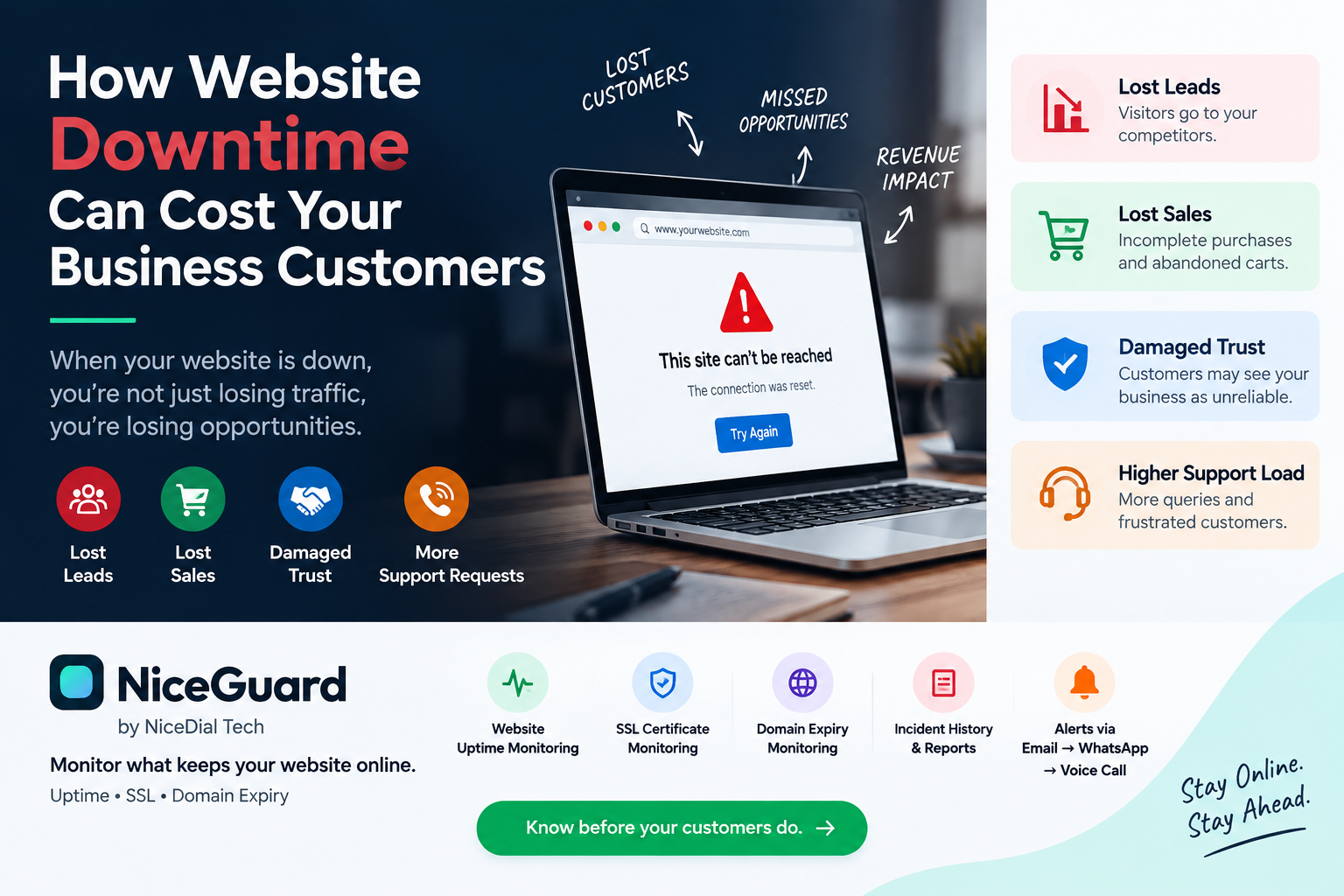
Your website may be available 99% of the time, but the few minutes when it isn’t available could be exactly when a potential customer is trying to contact you, make a purchase, submit an enquiry, or learn about your business.
For many businesses today, a website is more than an online brochure. It is a sales channel, lead-generation platform, customer support resource, and part of the company’s reputation.
When it goes down, the impact can extend far beyond a technical inconvenience.
The real problem is often even simpler:
Your customer discovers the outage before you do.
That’s exactly what website monitoring is designed to prevent.
What Is Website Downtime?
Website downtime is a period when visitors cannot access your website or an important part of it.
Instead of seeing your normal website, visitors might encounter:
- Connection timeout
- 500 Internal Server Error
- 502 Bad Gateway
- 503 Service Unavailable
- DNS errors
- Database connection errors
- SSL/certificate warnings
- Completely blank pages
- Extremely slow responses
Some failures affect an entire website, while others may only affect important pages such as login, checkout, registration, payment, API, or enquiry forms.
Either way, every failed visit can represent a lost opportunity.
1. Downtime Can Mean Lost Leads
Imagine someone searches Google for a service you provide.
They find your company, click your website and see:
“This site can’t be reached.”
Most visitors aren’t going to contact your IT department or wait for you to fix the problem.
They simply go back to Google and click the next result.
That means a website outage lasting only a few minutes can potentially cost you:
Website Visitor → Enquiry → Qualified Lead → Customer
The visitor doesn’t necessarily know that your website is experiencing a temporary technical issue.
From their perspective, your business simply wasn’t available when they needed it.
2. E-commerce Businesses Can Lose Sales Immediately
The impact becomes even more obvious for businesses that accept orders online.
Consider an e-commerce website receiving customers throughout the day.
If the website, shopping cart, checkout process or payment page stops working, customers may be unable to complete their purchases.
Even after the website comes back online, those customers may not return.
They may already have purchased the same product somewhere else.
Website monitoring therefore isn’t simply an IT requirement for e-commerce businesses. It can become part of revenue protection.
3. Downtime Can Damage Customer Trust
Customers expect digital services to be available.
Repeated errors can make visitors wonder:
- Is this business still operating?
- Is this website secure?
- Can I trust them with my payment?
- Will their service be reliable?
- Should I choose another company?
This is particularly important for businesses handling customer data, payments, appointments or other critical services.
A website outage may be temporary.
The impression it creates can last much longer.
4. SSL Expiry Can Look Like Website Downtime
Your server doesn’t necessarily have to fail for customers to stop accessing your website.
An expired or incorrectly configured SSL certificate can cause browsers to display security warnings.
Visitors may see messages indicating that their connection isn’t private or secure.
Many users will simply leave.
That’s why monitoring only whether a server responds isn’t enough.
Businesses should also monitor their SSL certificate validity and expiry dates.
5. An Expired Domain Can Be Even More Serious
Domain expiry is another risk that businesses sometimes overlook.
Your hosting server could be healthy.
Your application could be running.
Your SSL certificate could even be configured correctly.
But if your domain expires or develops a DNS problem, customers may still be unable to reach your website.
Monitoring domain expiry dates gives businesses enough warning to investigate and renew domains before they become a customer-facing problem.
6. Downtime Can Increase Support Requests
When an online service stops working, customers start looking for another way to contact you.
Your support team may suddenly receive messages such as:
“Your website isn’t opening.”
“I can’t log in.”
“The payment page isn’t working.”
“Is your service down?”
Now the outage isn’t only affecting customers.
It is also consuming the time of your support, operations and technical teams.
Early detection allows your team to start investigating before customer complaints begin accumulating.
7. The Longer Detection Takes, the Greater the Potential Impact
There are really two timelines during an outage:
When the problem started
and
When your team discovered it.
Suppose your website stops responding at 2:05 AM.
Nobody notices until someone checks it at 8:30 AM.
The technical issue lasted more than six hours before anyone even started investigating.
Automated monitoring changes this.
Instead of relying on someone manually checking the website, a monitoring service can continuously test it and generate an alert when a problem is detected.
Why Checking Your Website Manually Isn’t Enough
You might occasionally open your website and check that everything works.
That’s useful, but it isn’t monitoring.
No employee can realistically open every company website every few minutes, 24 hours a day, 365 days a year.
Problems can happen:
- Overnight
- During weekends
- During holidays
- Immediately after a deployment
- After hosting maintenance
- Following a DNS change
- After an SSL configuration change
Automated monitoring performs these checks continuously.
Don’t Depend Only on Email Alerts
Detecting downtime is only half the problem.
Someone also needs to notice the alert.
An email arriving at 2 AM may remain unread for several hours.
For important websites, businesses can benefit from an escalation approach:
Website issue detected
↓
Email Alert
↓
WhatsApp Alert
↓
Voice Call Alert
This makes critical incidents harder to overlook.
Introducing NiceGuard
NiceGuard by NiceDial Tech is designed to help businesses know about website problems before their customers have to tell them.
NiceGuard can help you monitor important website infrastructure from one place.
Website Uptime Monitoring
Continuously check whether your website is reachable and identify downtime incidents.
SSL Certificate Monitoring
Keep track of certificate validity and upcoming SSL expiry.
Domain Expiry Monitoring
Monitor your domains so important renewal dates aren’t forgotten.
Incident & Monitoring History
Maintain visibility into previous monitoring events and website incidents.
Escalating Alerts
Receive important notifications through:
Email → WhatsApp → Voice Call
The objective is simple:
Know about the problem before your customers do.
Who Should Monitor Website Uptime?
Website monitoring is valuable for almost any organization that depends on its online presence, including:
- E-commerce businesses
- SaaS companies
- Digital marketing agencies
- IT teams
- Hosting providers
- Hospitals and healthcare businesses
- Financial services companies
- Educational institutions
- Travel businesses
- Real estate companies
- Small and medium businesses
- WordPress website owners
If your website generates enquiries, revenue, bookings, registrations or customer interactions, its availability matters.
How Much Could Website Downtime Cost Your Business?
There isn’t one universal answer.
The cost depends on factors such as your website traffic, conversion rate, average transaction value, business model, outage duration and when the outage occurs.
But the calculation shouldn’t consider revenue alone.
The true impact can include:
Lost enquiries + Lost sales + Customer frustration + Support workload + Employee time + Reputation damage
For some businesses, one lost high-value lead could cost significantly more than the monitoring system designed to detect the outage.
Your Customers Shouldn’t Be Your Website Monitoring System
One of the worst ways to discover an outage is through a customer message:
“Hi, your website isn’t working.”
By that point, you don’t know how many other visitors encountered the same problem and simply left without telling you.
Automated website monitoring gives your team an opportunity to respond earlier.
NiceGuard helps monitor website uptime, SSL expiry and domain expiry and can escalate important alerts through Email → WhatsApp → Voice Call.
Start Monitoring Your Website with NiceGuard
Don’t wait for a customer to tell you that your website is down.
Monitor. Detect. Alert. Respond.
NiceGuard by NiceDial Tech — Know before your customers do.