Chatbots have been helping businesses automate customer conversations for years. They can answer frequently asked questions, display menus, collect basic information, and direct customers to the right department.
But a new generation of automation is changing what businesses can achieve: AI Agents.
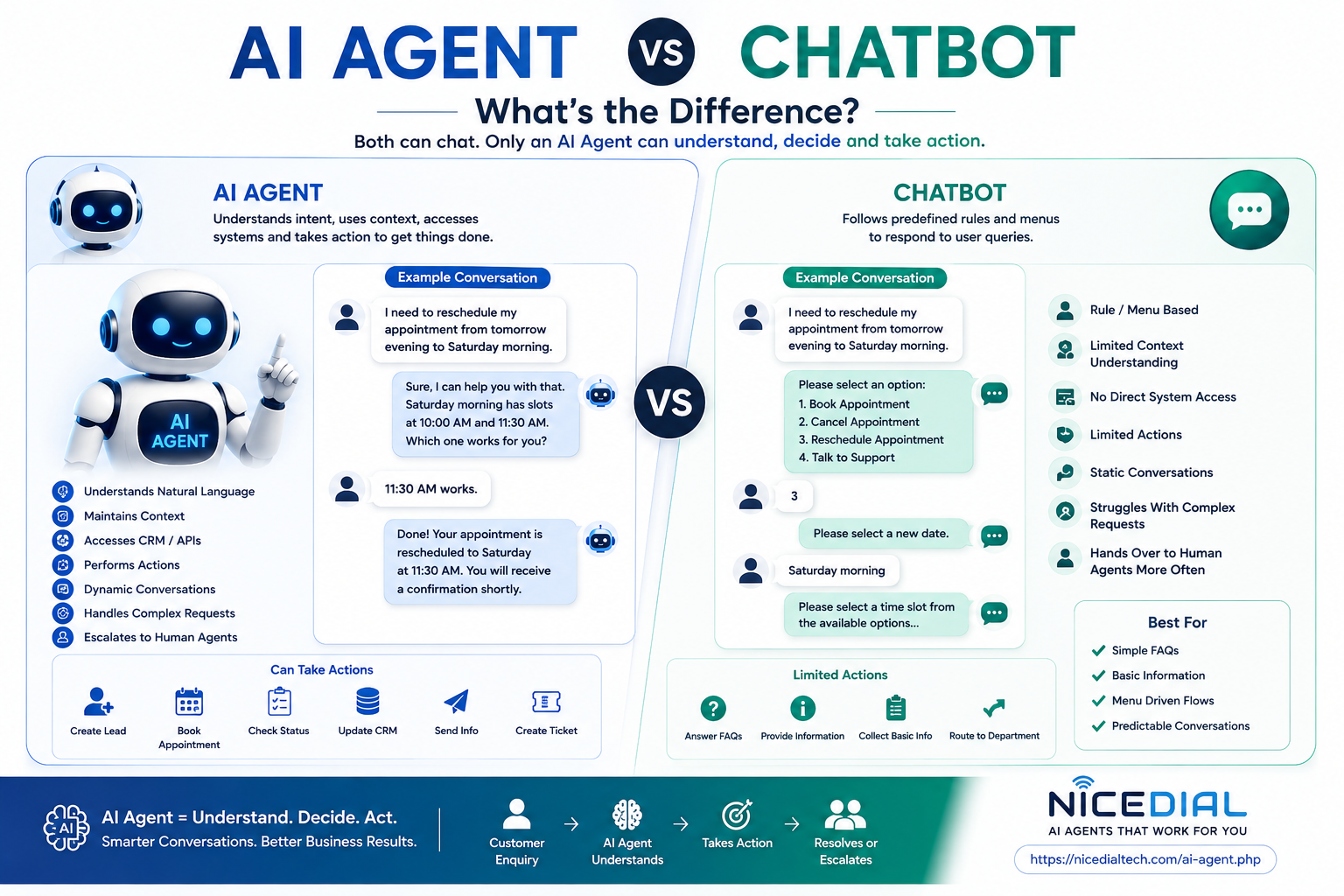
While a chatbot primarily focuses on responding to messages, an AI Agent can be designed to understand customer intent, maintain the context of a conversation, access business systems, perform tasks, and decide what should happen next within defined business rules.
So, what exactly is the difference between an AI Agent and a chatbot?
And which one should your business use?
Let’s understand.
What Is a Chatbot?
A chatbot is software designed to communicate with users through text or voice-based interfaces.
Traditional chatbots generally operate using predefined:
- Menus
- Keywords
- Questions
- Answers
- Decision trees
- Conversation flows
For example:
Customer: Hi
Chatbot: Welcome! How can we help?
- Sales
- Support
- Billing
- Talk to an Agent
The customer selects an option, and the chatbot follows the configured conversation flow.
This approach works well when customer requirements are predictable.
For example, a chatbot can efficiently answer:
“What are your business hours?”
“Where is your office?”
“What services do you provide?”
“How can I contact support?”
But things become more complicated when customers communicate naturally instead of following predefined options.
What Is an AI Agent?
An AI Agent is an AI-powered system designed not only to communicate with users but also to understand their requirements and perform predefined business actions.
Instead of requiring customers to navigate through menus, an AI Agent can understand natural-language requests.
For example:
Customer:
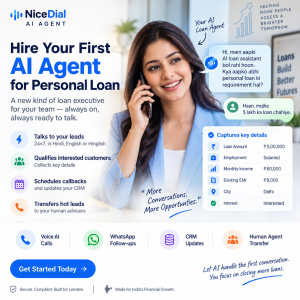
“I am looking for a personal loan of around ₹5 lakh. I am salaried and live in Gurgaon.”
An AI Agent could identify:
- Product: Personal Loan
- Required amount: ₹5 lakh
- Employment: Salaried
- Location: Gurgaon
- Intent: Loan enquiry
It could then ask for any additional information required by the business workflow.
The conversation becomes more natural while the AI Agent works toward a specific business objective.
AI Agent vs Chatbot: The Main Difference
The simplest way to understand the difference is:
A chatbot primarily answers and guides.
An AI Agent can understand, decide and take action within its configured capabilities.
Consider a customer who says:
“I need to reschedule my appointment from tomorrow evening to Saturday morning.”
Traditional Chatbot
A traditional chatbot might respond:
“Please select an option:
- Book Appointment
- Cancel Appointment
- Talk to Support”
The customer has to adapt to the chatbot’s predefined flow.
AI Agent
An AI Agent can understand that:
- An appointment already exists
- The customer wants to reschedule it
- Current appointment: Tomorrow evening
- Preferred new time: Saturday morning
If connected to the appointment system, the AI Agent could check available slots and continue:
“Saturday morning has appointments available at 10:00 AM and 11:30 AM. Which would you prefer?”
The customer communicates naturally while the AI handles the workflow.
AI Agent vs Chatbot: Quick Comparison
| Capability | Traditional Chatbot | AI Agent |
|---|---|---|
| Predefined responses | Yes | Yes |
| Menu-based conversations | Common | Optional |
| Natural-language understanding | Limited/Depends on platform | Advanced |
| Understand customer intent | Limited | Yes |
| Maintain conversation context | Limited | Yes |
| Ask contextual follow-up questions | Limited | Yes |
| Access CRM/API | Possible | Yes |
| Perform business actions | Limited/Rule-based | Yes, when integrated |
| Qualify leads | Rule-based | Dynamic |
| Book appointments | Through predefined flow | Conversational workflow |
| Human-agent escalation | Yes | Yes |
| Handle complex conversations | Limited | More capable |
| Voice conversations | Possible | Yes |
| Adapt conversation dynamically | Limited | Yes |
It is important to note that modern chatbot platforms can also include AI capabilities. The distinction therefore depends on how the system is designed rather than simply what it is called.
Example 1: Lead Qualification
Imagine a real estate company receives this enquiry:
Customer:
“I need a 3BHK in Gurgaon around ₹1.5 crore, preferably near Golf Course Road.”
Chatbot Approach
The bot might ask:
Select property type:
- 2BHK
- 3BHK
- 4BHK
Then:
Select budget range.
Then:
Select location.
The customer has already provided most of this information, but a rigid chatbot may ask for it again.
AI Agent Approach
The AI Agent can extract:
Property: 3BHK
Budget: Around ₹1.5 crore
Location: Gurgaon
Preferred area: Golf Course Road
It can then ask only for information that is still missing:
“When are you planning to purchase the property?”
The AI Agent can qualify the lead before sending it to the sales team.
Example 2: Appointment Booking
Consider a dental clinic.
Customer:
“My tooth has been hurting since yesterday. Can I see a dentist tomorrow evening?”
A traditional chatbot may start its appointment-booking menu.
An AI Agent can identify:
Requirement: Dental consultation
Preferred date: Tomorrow
Preferred time: Evening
If integrated with the clinic’s scheduling system, it can check availability and offer suitable appointment slots.
This reduces unnecessary steps for the patient.
Example 3: Customer Support
Suppose a customer says:
“I paid yesterday, but my account still shows payment pending.”
A traditional chatbot may show categories:
Payments → Payment Issues → Payment Pending
An AI Agent can immediately recognize this as a payment-status issue.
It could ask:
“I can help check that. Please share your transaction reference or registered mobile number.”
Depending on the available integrations and permissions, the AI Agent could retrieve the relevant status or escalate the case to a support employee.
Example 4: AI Voice Agent vs Traditional IVR
The difference becomes even clearer over a phone call.
Traditional IVR:
“Press 1 for Sales.”
“Press 2 for Support.”
“Press 3 for Accounts.”
Customers must navigate the menu.
With an AI Voice Agent, the interaction can become conversational.
AI Agent:
“How can I help you today?”
Customer:
“I submitted my loan application yesterday and want to check the status.”
The AI Agent can understand that the customer is asking about an existing loan application.
It can then follow the appropriate workflow.
Instead of:
Customer → IVR Menu → Submenu → Department
the experience becomes:
Customer → Natural Conversation → Intent Detection → Action
Can AI Agents Take Actions?
This is one of the most important differences.
When integrated with business systems, an AI Agent can potentially perform actions such as:
- Create a lead
- Update CRM records
- Check application status
- Schedule an appointment
- Schedule a callback
- Create a support ticket
- Retrieve approved customer information
- Send relevant information
- Trigger workflows
- Transfer conversations
- Notify employees
For example:
Customer:
“Please arrange a callback tomorrow morning.”
The AI Agent can collect the required information and create a callback request in the connected system.
This moves automation beyond simply answering questions.
AI Agents Can Connect With Your CRM
AI becomes much more useful when connected to business data and workflows.
Consider:
Customer → AI Agent → CRM → Business Rules → Response/Action
Suppose an existing customer contacts your business.
With appropriate integrations and authentication, the AI Agent could potentially retrieve relevant information from the CRM and provide a personalized response.
For a new prospect, the AI Agent could:
- Understand the enquiry
- Collect contact information
- Qualify the requirement
- Create a CRM lead
- Assign the lead
- Schedule a follow-up
- Transfer the conversation when required
This reduces manual data entry and repetitive work.
AI Agent + WhatsApp
Businesses receiving large numbers of WhatsApp enquiries can use AI Agents as the first layer of customer engagement.
For example:
Customer:
“Do you provide business loans?”
AI Agent:
“Yes. I can help you with your business loan enquiry. Approximately how much funding are you looking for?”
The AI Agent can continue the conversation, collect relevant information and qualify the enquiry.
When the customer needs a salesperson:
Customer:
“I’d like to speak with someone.”
The conversation can be transferred to a human agent.
With solutions such as WChat by NiceDial, businesses can combine AI automation with a shared team inbox and human-agent assistance.
AI Agent + Human Agent
AI Agents don’t have to replace employees.
A practical customer-engagement model is:
AI Agent + Human Agent
The AI Agent handles repetitive and structured interactions.
Human employees handle conversations requiring:
- Negotiation
- Judgment
- Complex problem-solving
- Sensitive situations
- Exceptions
- Relationship building
- Specialized expertise
For example:
Customer Enquiry
↓
AI Agent understands intent
↓
AI Agent attempts resolution or collects information
↓
Task completed?
YES → Customer receives resolution
NO → Transfer to Human Agent
The human employee can receive the conversation along with the information already collected.
When Should You Use a Traditional Chatbot?
A traditional chatbot can still be an excellent solution when your requirements are simple and predictable.
Consider a traditional chatbot when:
- You only need FAQs
- Customers follow predictable workflows
- You want simple menu-based navigation
- Your processes don’t require complex interpretation
- You need basic data collection
- You don’t need advanced AI reasoning
For many straightforward use cases, adding unnecessary AI can increase complexity without providing meaningful business value.
When Should You Use an AI Agent?
Consider an AI Agent when customers need to communicate naturally and the system needs to understand what they are trying to accomplish.
AI Agents are particularly useful when you want to:
- Automate complex enquiries
- Qualify leads conversationally
- Handle multiple customer intents
- Book appointments
- Integrate with CRM
- Connect with business APIs
- Automate support workflows
- Handle voice conversations
- Reduce repetitive work
- Provide 24×7 first-level assistance
- Escalate complex conversations to employees
Chatbot or AI Agent: Which Is Better?
There isn’t a universal answer.
The right solution depends on the business process.
For a simple FAQ:
Chatbot may be enough.
For a fixed menu:
Chatbot may be enough.
For collecting a few predefined fields:
Chatbot may be enough.
But when you want customers to communicate naturally and expect the system to understand their requirements and take appropriate actions:
An AI Agent may be the better solution.
Many businesses can also combine both.
A structured chatbot can handle predictable workflows while an AI Agent handles natural-language conversations and more dynamic requirements.
From Chatbot to AI Agent
The evolution of customer automation can be viewed as:
Menu-Based Bot
↓
Rule-Based Chatbot
↓
↓
AI Agent
↓
AI Agent + Business Systems + Human Team
The biggest change is not simply better conversation.
It is the ability to connect the conversation with real business workflows and actions.
Build an AI Agent for Your Business With NiceDial
At NiceDial Technology, we build AI-powered customer engagement solutions around real business workflows.
Depending on your requirements, a NiceDial AI Agent can be integrated with:
- Voice
- CRM
- Contact Center
- Business APIs
- Lead management systems
- Appointment systems
- Human agents
For example:
Customer
↓
AI Agent
↓
Understand Intent
↓
Retrieve or Collect Information
↓
Perform Business Action
↓
Resolve or Transfer to Human Agent
The objective isn’t simply to make a bot that talks.
The objective is to build an AI Agent that can contribute to completing a business process.
Ready to Move Beyond Traditional Chatbots?
If your business already uses a chatbot but customers are still navigating long menus, repeating information, or waiting for employees to complete routine tasks, it may be time to explore an AI Agent.
NiceDial AI Agents can be designed around your existing customer journey, business rules, CRM, APIs and contact-center workflows.
Explore NiceDial AI Agent:
https://nicedialtech.com/ai-agent.php
Request a demo and see how an AI Agent can work with your actual business use case.
NiceDial Technology
AI Agents | AI Voice Bots | WhatsApp Automation | CRM | Contact Center Solutions
Frequently Asked Questions
Is an AI Agent the same as a chatbot?
No. Although both can communicate with customers, an AI Agent can be designed to understand natural-language requests, maintain context and perform actions through connected business systems. Traditional chatbots commonly rely more heavily on predefined menus and conversation flows.
Can an AI Agent replace my existing chatbot?
Yes, in some cases. However, replacing the entire chatbot may not always be necessary. Businesses can combine deterministic chatbot workflows with AI Agents depending on the use case.
Can AI Agents integrate with CRM?
Yes. If the CRM provides suitable APIs or integration mechanisms, an AI Agent can potentially create leads, retrieve approved information, update records and trigger workflows.
Can AI Agents work on WhatsApp?
Yes. AI Agents can be integrated into WhatsApp customer-engagement workflows using appropriate WhatsApp Business integrations.
Can an AI Agent talk to customers over the phone?
Yes. AI Voice Agents can use speech recognition, natural-language processing and text-to-speech technologies to conduct voice conversations over supported telephony infrastructure.
Can AI Agents transfer conversations to humans?
Yes. Human escalation can be configured so that conversations are transferred when the AI cannot resolve the request or when human assistance is appropriate.
Which is better: AI Agent or chatbot?
For simple menus and FAQs, a traditional chatbot may be sufficient. For natural conversations, dynamic lead qualification, business-system integration and task automation, an AI Agent can provide greater capabilities.