Customers today expect businesses to respond quickly—whether they are asking a question, checking a service, requesting a quotation, booking an appointment, or following up on an existing request.
But having employees available 24×7 to handle every enquiry is expensive and difficult to scale.
This is where AI Agents can help.
An AI Agent can communicate with customers, understand what they need, perform predefined business tasks, collect information, qualify leads, schedule appointments, and transfer conversations to human agents when necessary.
For businesses looking to improve customer experience while reducing repetitive work, AI Agents can become an important part of their customer engagement strategy.
What Is an AI Agent?
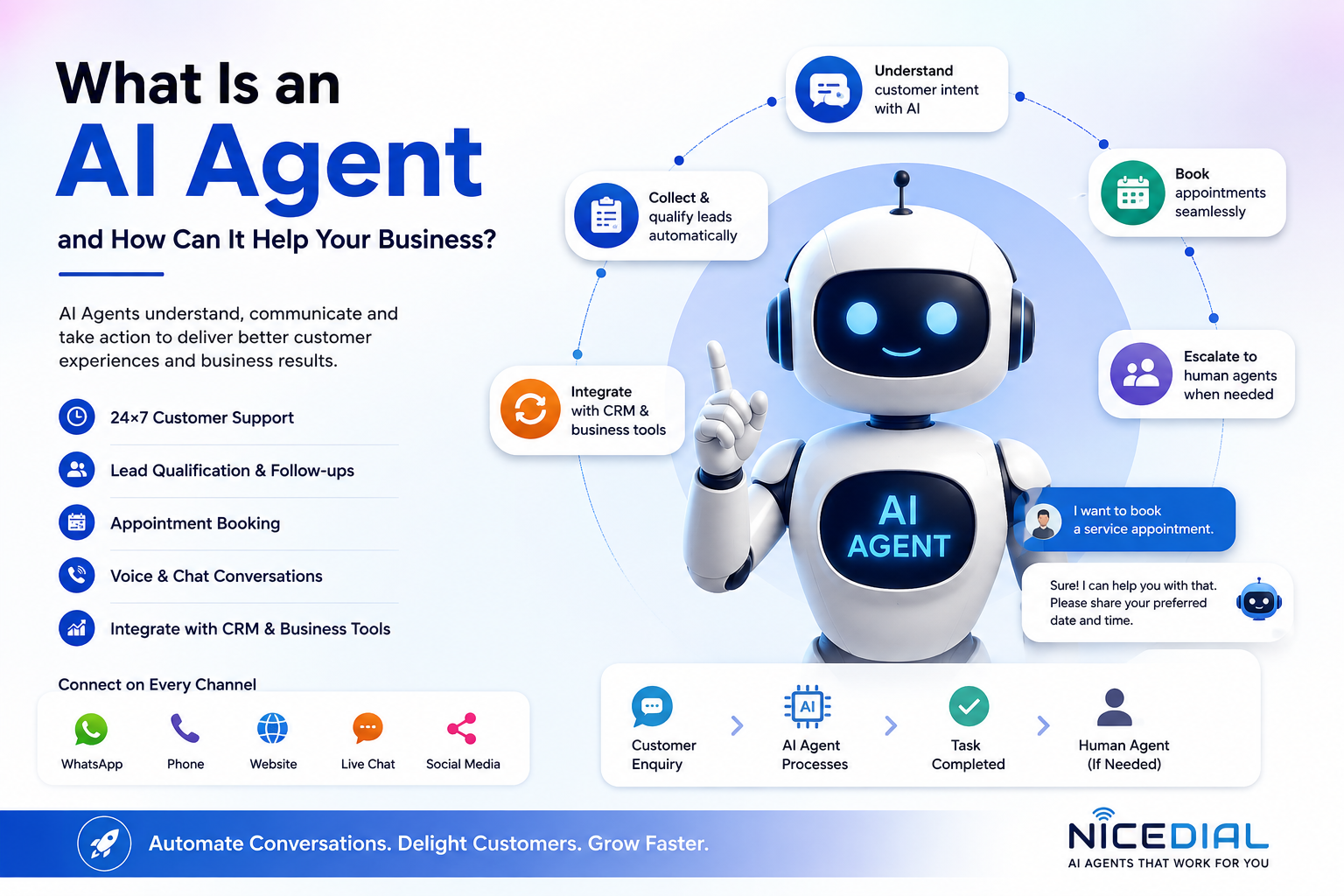
An AI Agent is an AI-powered software system designed to interact with customers and perform specific tasks based on business rules, available information, and connected systems.
Unlike a basic chatbot that mainly responds using predefined questions and answers, an AI Agent can be designed to understand the customer’s intent and decide what action should happen next.
For example, imagine a customer sends this message:
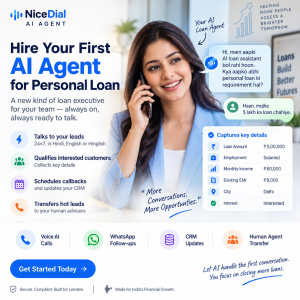
“I want to know if I am eligible for a personal loan.”
Instead of simply displaying a menu, an AI Agent could:
- Understand that the customer is interested in a personal loan.
- Ask for the required eligibility information.
- Collect details such as income, employment type, city, and desired loan amount.
- Validate the information using predefined business rules or connected APIs.
- Qualify the lead.
- Send the qualified lead to the sales team or CRM.
- Schedule a callback if required.
The conversation becomes an automated business workflow rather than just a question-and-answer interaction.
AI Agent vs Traditional Chatbot
Traditional chatbots are useful for simple and predictable conversations.
For example:
Customer: I need support.
Bot:
Press 1 for Sales
Press 2 for Support
Press 3 for Billing
An AI Agent can provide a more natural experience.
Customer: I made a payment yesterday, but it is still not showing in my account.
AI Agent: I can help you check that. Please share your registered mobile number or transaction reference.
The AI Agent understands the customer’s intention and can guide the conversation accordingly.
This can reduce the number of steps customers need to take before reaching the right solution.
What Can an AI Agent Do for Your Business?
AI Agents can be configured for many different customer-facing and internal workflows.
1. Answer Customer Enquiries 24×7
Customers don’t always contact a business during office hours.
An AI Agent can handle common enquiries at any time, including:
- Product and service information
- Pricing questions
- Business hours
- Appointment availability
- Application status
- Order or service status
- Frequently asked questions
When an enquiry requires human intervention, the conversation can be transferred to an available agent.
2. Automatically Qualify Leads
Not every enquiry is a qualified sales opportunity.
Your AI Agent can ask relevant questions before sending a lead to your sales team.
For example, a real estate company could automatically ask:
- Which location are you interested in?
- What is your budget?
- Are you looking for residential or commercial property?
- When are you planning to purchase?
- Would you like to schedule a site visit?
The sales team receives better-qualified opportunities instead of manually asking the same questions repeatedly.
3. Book Appointments Automatically
AI Agents can also be integrated with appointment or scheduling systems.
A customer could simply say:
“I need a dental appointment tomorrow evening.”
The AI Agent can collect the necessary information, check available appointment slots through an integrated system, and help complete the booking.
This approach can be useful for:
- Hospitals
- Clinics
- Dental clinics
- Diagnostic centers
- Salons
- Automobile service centers
- Real estate site visits
- Product demonstrations
- Sales consultations
4. Automate Customer Follow-Ups
Sales teams often lose opportunities because leads are not followed up at the right time.
AI Agents can support structured follow-up workflows.
For example:
Day 1: Customer submits an enquiry.
Immediately: AI Agent responds and collects requirements.
Later: A follow-up can be triggered according to the configured workflow.
If interested: Lead is transferred to a salesperson.
If not ready: The lead can be placed into an appropriate follow-up journey, subject to the communication channel’s rules and customer consent.
This allows sales representatives to spend more time speaking with interested prospects.
5. Connect AI With WhatsApp
WhatsApp is an important customer communication channel for many businesses.
An AI Agent integrated with an official WhatsApp Business solution can help businesses automate conversations such as:
Customer: I want to book a service.
AI Agent: Sure. Which vehicle would you like to service?
Customer: Hyundai Creta.
AI Agent: Please select your preferred service date.
The AI Agent can collect the required information and pass the conversation to a human agent whenever necessary.
With WChat by NiceDial, businesses can combine WhatsApp automation, AI Bots, shared team inboxes, and human-agent support in one workflow.
6. Handle Phone Calls With AI Voice Agents
AI Agents are not limited to text conversations.
An AI Voice Agent can interact with customers over phone calls using natural-language conversations.
Instead of hearing:
“Press 1 for Sales. Press 2 for Support. Press 3 for Accounts.”
A customer can simply explain what they need.
For example:
Customer: I want to know the status of my loan application.
The AI Voice Agent can identify the request, collect or verify the required details, access an integrated system where permitted, and provide the appropriate response or transfer the call.
This creates a more conversational alternative to traditional IVR systems for suitable use cases.
7. Transfer Conversations to Human Agents
AI doesn’t need to handle every conversation.
A well-designed AI Agent should know when human assistance is required.
For example:
Customer: I still have a problem and want to speak with someone.
The system can transfer the conversation to a human agent along with the information already collected.
The employee doesn’t have to restart the conversation by asking the customer the same questions again.
This creates an effective combination:
AI Automation + Human Expertise
Where Can Businesses Use AI Agents?
AI Agents can be customized for different industries.
Healthcare
Hospitals and clinics can use AI Agents for:
- Patient enquiries
- Appointment booking
- Appointment reminders
- Doctor availability
- Diagnostic test enquiries
- Follow-ups
- Frequently asked questions
Banking, Loans & Fintech
Financial businesses can use AI Agents for:
- Lead qualification
- Loan enquiries
- Application guidance
- Callback scheduling
- Document requirement information
- Customer support workflows
Sensitive or regulated decisions should remain subject to appropriate business rules, compliance controls, and human oversight.
Real Estate
AI Agents can help with:
- Property enquiries
- Budget qualification
- Location preferences
- Project information
- Site visit scheduling
- Lead follow-ups
Automobile Businesses
Dealerships and service centers can automate:
- Test-drive requests
- Service bookings
- Vehicle enquiries
- Service reminders
- Insurance renewal enquiries
- Customer follow-ups
Education
Schools, colleges, universities, and training institutes can use AI Agents for:
- Admission enquiries
- Course information
- Fee-related FAQs
- Counselling requests
- Campus visit scheduling
- Application guidance
Hotels & Hospitality
AI Agents can assist with:
- Room enquiries
- Booking-related questions
- Property information
- Guest requests
- Frequently asked questions
- Escalation to hotel staff
Benefits of Using an AI Agent
A properly implemented AI Agent can help businesses:
Respond Faster
Customers can receive an immediate response instead of waiting for an available employee.
Provide 24×7 First-Level Assistance
Routine enquiries can continue outside normal business hours.
Reduce Repetitive Work
Employees spend less time answering the same questions repeatedly.
Improve Lead Qualification
Sales teams can receive leads with useful information already collected.
Create Consistent Customer Experiences
Business rules and approved information can be applied consistently across conversations.
Scale Customer Conversations
Businesses can handle larger enquiry volumes without increasing manual work at the same rate.
Improve Agent Productivity
Human agents can focus on complex conversations, negotiations, exceptions, and relationship building.
AI Agents Don’t Have to Replace Human Agents
One of the most practical ways to deploy AI is not:
AI vs Humans
but:
AI + Humans
AI can handle repetitive and structured interactions while employees handle conversations requiring judgment, empathy, negotiation, or specialized knowledge.
For example:
Customer Enquiry → AI Agent → Understand Intent → Collect Information → Resolve Automatically OR Transfer to Human Agent
This allows businesses to automate where automation makes sense while keeping people involved where they add the most value.
How NiceDial AI Agents Can Help
NiceDial Technology provides AI-powered customer engagement solutions that can combine:
- AI Chat Agents
- AI Voice Agents
- WhatsApp automation
- WChat Shared Inbox
- Human-agent assistance
- CRM integration
- Contact Center integration
- Lead qualification
- Appointment booking
- Workflow automation
- API integration
The objective is not simply to create another chatbot.
The objective is to build an AI Agent around your actual business process.
For example:
Customer → WhatsApp / Phone → AI Agent → Qualification → CRM → Human Agent → Follow-up
The exact workflow can be customized according to the business use case.
Ready to See an AI Agent in Action?
Imagine having an AI Agent that can answer customer enquiries, qualify prospects, schedule appointments, assist customers, and involve your team whenever human assistance is required.
That’s the type of customer journey businesses can build with NiceDial.
Want to see how an AI Agent could work for your business?
Request a live demo from NiceDial Technology and we can demonstrate an AI Agent using a workflow relevant to your industry.
NiceDial Technology
AI Agents | AI Voice Bots | WhatsApp Automation | CRM | Contact Center Solutions
🌐 Website: nicedialtech.com
Frequently Asked Questions
What is an AI Agent?
An AI Agent is an AI-powered software system that can understand user requests, respond conversationally, and perform predefined actions or workflows based on available information and integrations.
Is an AI Agent the same as a chatbot?
Not necessarily. Traditional chatbots often follow fixed conversational flows, while more advanced AI Agents can understand natural-language requests and perform actions through connected systems.
Can AI Agents work on WhatsApp?
Yes. AI Agents can be integrated into WhatsApp-based customer engagement workflows using appropriate WhatsApp Business integrations.
Can an AI Agent make and receive phone calls?
Voice-enabled AI Agents can be integrated with telephony systems to handle supported inbound or outbound calling workflows.
Can an AI Agent transfer a customer to a human?
Yes. Human escalation can be built into the workflow so that conversations requiring manual assistance are transferred to the appropriate employee or team.
Does an AI Agent work 24×7?
AI systems can be made available continuously, subject to the availability of the underlying infrastructure, APIs, communication channels, and integrated services.
Can AI Agents integrate with CRM software?
Yes. Depending on the CRM and available APIs, an AI Agent can send or retrieve information, create leads, update records, schedule follow-ups, or trigger other workflows.
Which businesses can use AI Agents?
AI Agents can be useful across healthcare, financial services, real estate, education, automobile, hospitality, e-commerce, customer support, and many other industries where businesses handle repetitive customer interactions.