“Press 1 for Sales.”
“Press 2 for Customer Support.”
“Press 3 for Billing.”
For decades, Interactive Voice Response (IVR) has helped businesses automate incoming calls and route customers to the right department.
IVR remains useful.
But customer expectations have changed.
Customers increasingly expect faster, more natural interactions. They don’t necessarily want to navigate several menu levels just to explain something they already know:
Why they’re calling.
This is where an AI Voice Agent changes the experience.
Instead of asking customers to understand your menu structure, an AI Voice Agent can begin with a much simpler question:
“Hello. How can I help you today?”
The customer speaks naturally, the AI identifies the intent, asks follow-up questions, connects with approved business systems when required, and either completes the workflow or transfers the call to a human agent.
So, AI Voice Agent vs Traditional IVR: which one should your business use?
Let’s compare.
What Is Traditional IVR?
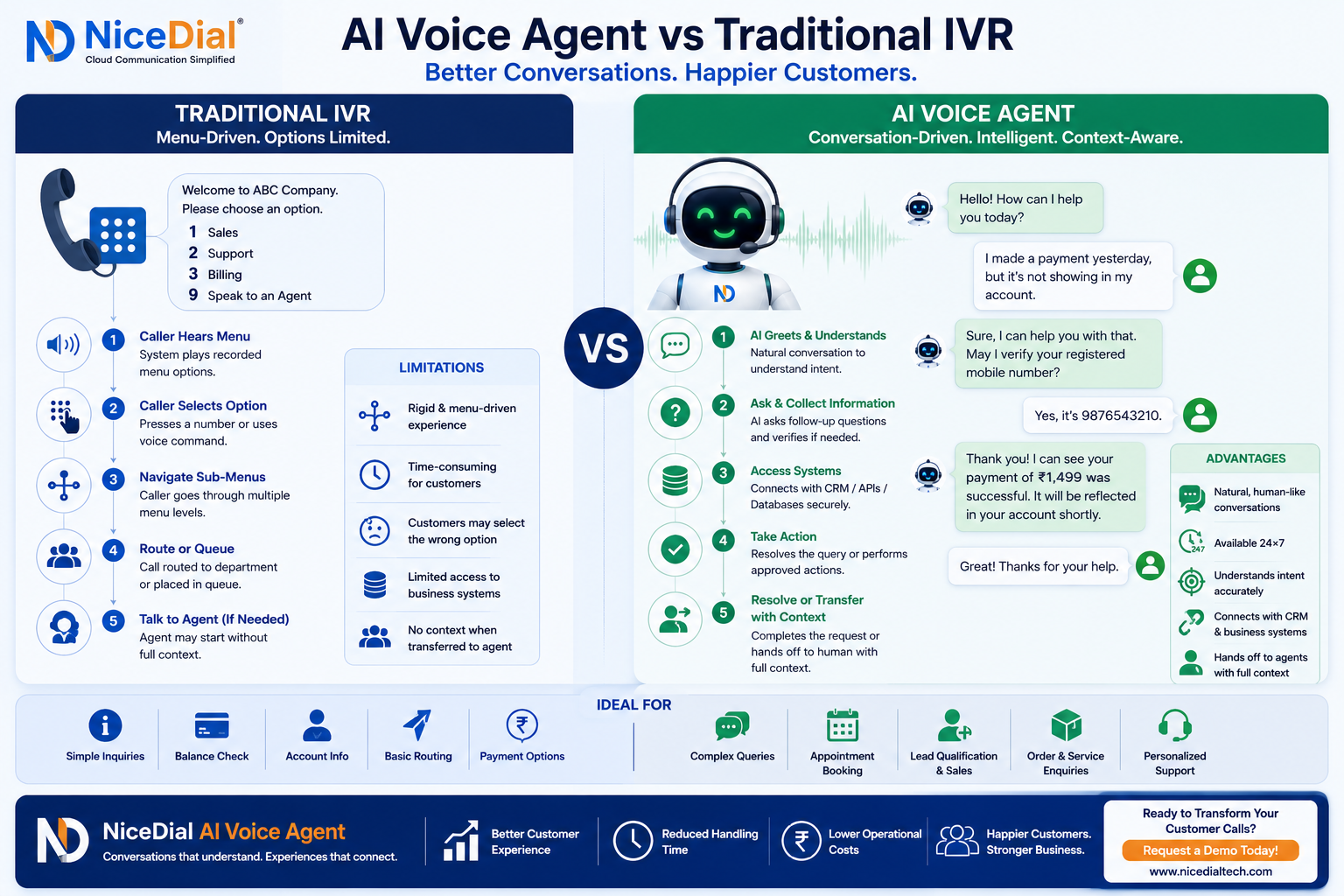
IVR (Interactive Voice Response) is a telephone automation system that interacts with callers through keypad selections or predefined voice commands.
A typical IVR journey looks like:
Incoming Call
↓
Select Language
↓
Press 1 for Sales
Press 2 for Support
Press 3 for Billing
↓
Select Sub-Menu
↓
Queue
↓
Human Agent
The caller navigates a predefined decision tree created by the business.
IVR is highly effective when customer journeys are predictable and structured.
For example:
“Press 1 to check your account balance.”
“Press 2 to make a payment.”
“Press 3 to speak with an agent.”
The system knows exactly what should happen after each selection.
What Is an AI Voice Agent?
An AI Voice Agent uses conversational AI to understand spoken customer requests and respond through natural voice conversations.
Instead of:
“Press 1 for an existing booking.”
the AI can ask:
“How can I help you?”
The customer might say:
“I have an appointment tomorrow but need to move it to Friday.”
The AI can identify the intent as:
Appointment Rescheduling
It can then ask relevant questions, verify the customer when required, check available slots through an integrated system, and continue the workflow.
A typical AI Voice Agent journey can look like:
Incoming Call
↓
AI Answers
↓
Customer Explains Requirement
↓
AI Understands Intent
↓
AI Asks Follow-Up Questions
↓
CRM / API / Business-System Lookup
↓
Take Approved Action
↓
Resolve or Transfer to Human
The major difference is that the customer isn’t required to understand the company’s menu structure.
AI Voice Agent vs Traditional IVR: Quick Comparison
| Traditional IVR | AI Voice Agent |
|---|---|
| Menu-based interaction | Natural conversation |
| “Press 1, Press 2” | “How can I help you?” |
| Predefined decision tree | Context-aware conversation |
| Customer selects intent | AI identifies intent |
| Limited flexibility | Can handle varied expressions |
| Keypad/command based | Natural spoken language |
| Fixed sequence | Can ask contextual follow-up questions |
| Basic routing | Intent-based routing |
| Limited interruption handling | Can support conversational interruptions |
| Usually predefined data flows | Can integrate with CRM and APIs |
| Transfers based on menu choice | Can transfer with conversation context |
| Excellent for deterministic flows | Better suited to dynamic conversations |
Neither technology is automatically better for every use case.
The right choice depends on the customer journey.
Example 1: Traditional IVR Customer Experience
Imagine a customer calling an insurance company because their policy expires next week.
The experience might be:
IVR:
“Welcome to ABC Insurance.”
“For English, press 1.”
Customer presses 1.
“For new policies, press 1.”
“For existing policies, press 2.”
Customer presses 2.
“For policy information, press 1.”
“For claims, press 2.”
“For renewal, press 3.”
Customer presses 3.
The customer may eventually reach the appropriate workflow.
The system works.
But the customer had to understand how the company categorized their requirement.
Example 2: AI Voice Agent Customer Experience
Now imagine the same call with an AI Voice Agent.
AI Voice Agent:
“Welcome to ABC Insurance. How can I help you?”
Customer:
“My car insurance expires next week. I want to know the renewal amount.”
The AI identifies:
Intent: Insurance Renewal
It can then continue:
“Sure. Let me help you with your policy renewal. May I verify your registered mobile number?”
Once the customer is verified, the AI can potentially query the appropriate business system and continue the approved renewal workflow.
The customer doesn’t have to navigate multiple menus.
They simply explain what they want.
The Biggest Difference: Menu vs Conversation
Traditional IVR asks:
“Which option do you want?”
AI Voice Agent asks:
“What do you need?”
That’s the fundamental difference.
IVR requires businesses to predict possible customer journeys in advance and organize them into menu trees.
AI Voice Agents can provide greater flexibility when customers describe the same requirement in different ways.
For example:
“Change my appointment.”
“I can’t come tomorrow.”
“Move my doctor’s appointment.”
“Can I come on Friday instead?”
All of these could represent the same intent:
Appointment Rescheduling
The AI can interpret the conversation instead of requiring the customer to find the correct menu.
AI Voice Agents Can Ask Follow-Up Questions
Customers rarely provide every required detail in one sentence.
For example:
Customer:
“I need to book a service.”
The AI might ask:
“Sure. Which vehicle would you like to book for service?”
Then:
“Which day would you prefer?”
Then:
“Would morning or afternoon work better?”
The conversation adapts according to the customer’s answers.
Traditional IVR can also collect information, but typically through predefined branches.
AI Voice Agents can make the interaction feel more conversational.
AI Voice Agents Can Handle Interruptions
Real people interrupt conversations.
Consider:
AI:
“Your appointment is scheduled for Monday at—”
Customer:
“Wait, can you check Tuesday instead?”
A conversational AI system can be designed to detect the interruption, understand the new request, maintain context, and continue appropriately.
Traditional IVR usually expects customers to follow a predetermined sequence.
This makes interruption handling an important advantage for conversational Voice AI.
CRM and API Integration
A voice system becomes much more useful when it can interact with the systems behind your business.
An AI Voice Agent can potentially connect with:
- CRM
- Customer database
- Appointment system
- Hospital management system
- Loan management system
- Helpdesk
- Order management platform
- ERP
- Ticketing system
- Custom APIs
Imagine a customer asks:
“What’s the status of my application?”
The workflow could become:
Customer Request
↓
AI Identifies Intent
↓
Customer Verification
↓
API Lookup
↓
Application Status Retrieved
↓
AI Provides Approved Response
The AI is no longer simply answering FAQs.
It becomes part of the business workflow.
AI Voice Agents Can Perform Actions
Customers don’t always call just to ask questions.
They may want to:
- Book an appointment
- Reschedule an appointment
- Create a service request
- Request a callback
- Check an application
- Capture a sales enquiry
- Qualify a lead
- Schedule a demo
- Register a complaint
- Create a support ticket
When the appropriate integrations and permissions exist, an AI Voice Agent can trigger approved workflows.
For example:
Customer:
“I want to reschedule my appointment to Friday.”
AI:
“I can see an available slot at 4:30 PM. Would you like me to book it?”
Customer:
“Yes.”
AI:
“Your appointment has been rescheduled to Friday at 4:30 PM.”
One natural conversation can potentially replace several menu selections and manual steps.
Traditional IVR Still Has Important Advantages
AI Voice Agents are powerful, but that doesn’t make traditional IVR obsolete.
There are many situations where IVR remains an excellent choice.
Predictable Workflows
If there are only three possible actions, a menu may be faster and simpler.
Deterministic Processes
Businesses may require every customer to follow exactly the same workflow.
Compliance-Driven Scripts
Some interactions require tightly controlled wording and predictable execution.
Simple Routing
If the objective is simply:
Sales → Support → Billing
AI may not be necessary.
Cost and Complexity
A straightforward IVR can be simpler to build, operate, test, and maintain than a conversational AI deployment.
The question shouldn’t be:
“How do we replace every IVR with AI?”
The better question is:
“Which customer journeys actually benefit from conversation?”
When Should You Use an AI Voice Agent?
AI Voice Agents are particularly useful when:
- Customers ask varied questions
- Natural conversation improves the experience
- Callers frequently choose the wrong IVR option
- Multiple follow-up questions may be required
- Customers interrupt or change their request
- CRM/API information is needed during the call
- Calls involve multi-step workflows
- Intent cannot easily be represented by a small menu
- After-hours automation is important
- Contextual human handoff is required
For these situations, conversational AI can provide significantly more flexibility than a traditional menu tree.
What Happens When AI Cannot Handle the Call?
This is critical.
An AI Voice Agent shouldn’t try to answer everything.
Businesses need guardrails.
A practical architecture could follow:
AI understands + authorized → Respond
Approved action available → Execute
Additional information required → Ask
Uncertain → Clarify
Outside scope → Transfer
Sensitive or complex → Human Agent
Knowing when not to automate is an important part of implementing Voice AI responsibly.
AI Voice Agent to Human Agent Handoff
Traditional IVR usually routes the caller to a queue.
The human agent may receive little context beyond the selected department.
An AI Voice Agent can potentially provide much richer context.
For example:
Customer: Rahul Sharma
Intent: Payment issue
Verification: Completed
Issue: Payment made yesterday but account not updated
Transaction: Identified
AI Action: Payment status checked
Reason for Transfer: Manual investigation required
The human agent can start with:
“Rahul, I understand you’re calling because yesterday’s payment hasn’t reflected in your account. Let me investigate that.”
Instead of:
“Hello. How can I help you?”
The customer doesn’t need to repeat the entire story.
AI Voice Agent vs IVR for 24×7 Customer Support
Both IVR and AI can operate outside normal business hours.
The difference is what they can potentially accomplish.
Traditional IVR
A caller may:
- Select a department
- Hear recorded information
- Perform predefined self-service actions
- Leave a voicemail
- Request a callback
AI Voice Agent
A caller may potentially:
- Explain the requirement naturally
- Ask follow-up questions
- Verify their identity
- Retrieve information
- Perform approved actions
- Schedule appointments
- Create requests
- Receive contextual responses
- Escalate when required
This can make Voice AI particularly useful for businesses trying to expand the scope of 24×7 automated customer service.
Which Industries Can Benefit From AI Voice Agents?
Healthcare
Traditional IVR:
“Press 1 for appointments.”
AI Voice Agent:
“I need to move tomorrow’s appointment to Saturday.”
Potential use cases include appointment booking, rescheduling, reminders, and patient enquiries.
Banking & Fintech
Voice AI can support suitable workflows for lead qualification, application enquiries, payment reminders, callbacks, and customer-service requests.
Insurance
Potential applications include policy enquiries, renewal conversations, lead qualification, and customer follow-up.
Automobile
Customers can request service bookings, test drives, callbacks, and other routine assistance conversationally.
Real Estate
AI can help qualify property enquiries, understand budgets and locations, and schedule site visits.
Education
AI Voice Agents can handle admission enquiries, course information, counselling scheduling, and student follow-ups.
Contact Centers
AI can complement existing contact-center infrastructure with conversational self-service, intelligent routing, and automated call workflows.
The Better Strategy May Be AI + IVR + Humans
Businesses don’t necessarily need to choose between AI Voice Agents and IVR.
A hybrid architecture can often provide the best result.
Traditional IVR
Use it for simple and deterministic journeys.
AI Voice Agent
Use it for natural conversations and dynamic workflows.
Human Agent
Use people for complex cases, empathy, investigation, negotiation, and exceptions.
A modern customer communication architecture might look like:
Customer Call
↓
↓
IVR / Voice Bot / AI Voice Agent
↓
CRM + APIs + Business Systems
↓
Human Agent When Required
Different calls can take different paths depending on the requirement.
AI Voice Agent vs Traditional IVR: Which Should You Choose?
Choose Traditional IVR when:
- Customer options are limited
- The journey is predictable
- You need deterministic automation
- Simple call routing is enough
- You want a straightforward automation workflow
Choose an AI Voice Agent when:
- Customers need natural conversations
- Requirements vary significantly
- Context matters
- Follow-up questions are common
- CRM/API interaction is required
- You want more flexible 24×7 automation
- Intelligent human handoff is important
Choose a hybrid approach when you have both types of customer journeys.
For many businesses, this will be the most practical architecture.
NiceDial AI Voice Agent
NiceDial AI Agent is designed for businesses that need more conversational customer interactions beyond rigid menu-based automation.
The platform can support natural voice conversations, follow-up questions, interruptions, business-system interactions, configurable guardrails, and contextual escalation to human agents.
Combined with NiceDial Cloud Telephony, businesses can build customer communication workflows that bring together:
Cloud Telephony + IVR + Voice Bot + AI Voice Agent + CRM/APIs + Human Agents
The goal isn’t to use AI on every call.
It’s to use the right technology for each customer conversation.
Stop Asking Customers to Understand Your IVR
Your customer already knows what they need.
Instead of making them think:
“Should I press 2 or press 3?”
let them simply say:
“I need to reschedule my appointment.”
That’s the shift from menu-driven automation to conversation-driven automation.
Traditional IVR isn’t disappearing.
But AI Voice Agents are giving businesses a new way to handle calls that don’t fit neatly inside a menu tree.
🚀 Explore NiceDial AI Agent
Discover how NiceDial can help you combine AI Voice Agents, traditional IVR, Cloud Telephony, CRM integrations, and human agents into a modern customer communication platform.
👉 Request a Demo / Technical Walkthrough:
https://nicedialtech.com/ai-agent.php
Let IVR handle predictable journeys. Let AI handle conversations. Let humans handle what matters most.
Frequently Asked Questions
What is the difference between an AI Voice Agent and IVR?
Traditional IVR guides callers through predefined menus using keypad selections or simple voice commands. An AI Voice Agent allows customers to explain their requirements naturally and can use conversational context to determine the appropriate response or workflow.
Can an AI Voice Agent replace IVR completely?
Technically, AI can automate many interactions traditionally handled by IVR, but complete replacement isn’t always necessary. Simple and deterministic workflows may still be better suited to traditional IVR. A hybrid architecture can often provide better results.
Can AI Voice Agents connect to CRM systems?
Yes. AI Voice Agents can be integrated with CRM platforms, APIs, databases, scheduling systems, helpdesks, and other supported business applications, subject to available integrations and permissions.
Can an AI Voice Agent transfer a call to a human?
Yes. The AI workflow can transfer calls when human assistance is required and can provide relevant conversation context to help the human agent continue the interaction.
Can AI Voice Agents handle calls 24×7?
AI Voice Agents can be configured for 24×7 availability, subject to the availability of the underlying telephony platform, infrastructure, integrations, and connected business systems.
Is an AI Voice Agent more expensive than IVR?
It depends on call volume, AI processing, telephony, integrations, infrastructure, and the complexity of the use case. Traditional IVR can be more economical for very simple workflows, while AI Voice Agents may provide greater value for complex conversational interactions.
NiceDial AI Agent:
https://nicedialtech.com/ai-agent.php
NiceDial Cloud Telephony:
https://nicedialtech.com/cloud-telephony.php